| Author | |
|---|---|
| Translated by | |
| Imprint | |
| Publication Year | 2015 |
| Language | English |
| Edition | 1 |
| Binding | Paperback |
| Pages | 116 |
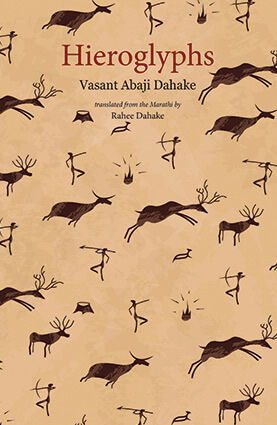
Hieroglyphs
$29
About the Book
Hieroglyphs is a translation of Sahitya Akademi Award winning collection in Marathi- Chitralipi by Vasant Abaji Dahake. It has been translated into the English by Rahee Dahake.
Related products
-
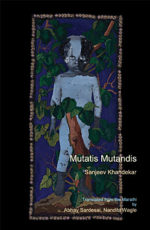
Mutatis Mutandis
$10About the Book
Through sex-dolls and addictions, for whom poetry can be just another narcotic throbbing in your vein. Khandekar’s man has stretched himself to the limits of the Machiavellian primate, modifying his behaviour and absurdum to fit in with the changing patterns of a world spinning out of control on the wheel of progress. Meet the ghost in the machine Sanjeev Khandekar’s poetry grins impishly, then socks you in the eye. It makes you feel horns on your head and inspect your skin for green stripes. Khandekar breaks conventions of belief, language and genre to offer a world with no certainties, where you are just a gob of self-awareness floating in a matrix of virtual reality, mutating every moment to balance your inner needs with social expectations. You are the Mutatis Mutandis Man the human ‘with necessary changes’ carried out the modified man tossed between inscrutable science and enigmatic religious faith, the creature who gropes for love and creativity that may lure you towards self-destruction. Meet Khandekar’s Monster and see if he seems familiar.
Khandekar’s poetry, like his art, is disturbingly unconventional; and Abhay Sardesai and Nandita Wagle’s excellent translation from Marathi now brings it to the English reader.
-Antara Dev Sen -
-
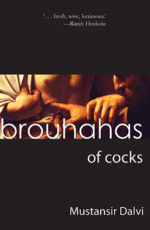
Brouhahas Of Cocks
$15About the Book
Hardback awakening The air is thick, and has revived my books, anticipating the first spell of a Bombay monsoon. Ambient moisture has slaked pages that shuffle and twist, arise to a wakefulness, unleaving. Feeling the discomfort of nearness,
-
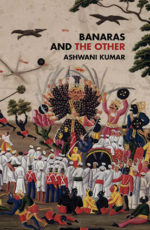
Banaras And The Other
$14About the Book
Ashwani Kumar’s poems in ‘Banaras and The Other” are a mischievous irreverence turned at times to the present and at times to the past. The personal and the political, memories and nostalgia, mythical characters and contemporary parodies mix and mingle in these poems in diverse proportions to produce a rare poetic energy that belongs entirely to our times of pain and paradox. –K. Satchidanandan
Ashwani Kumar’s Banaras and the Other captivates us as a delightful romp through myth, folklore and history. Read past the revelry, however, and you will see that it engages passionately and provocatively with the fissured, schismatic scenarios of 21st century India.–Ranjit Hoskote
-

Last-Ditch Ecstasy
$14About the Book
Adrian Grima in collaboration with his talented and unusually resourceful translator, Albert Gatt – has produced a rich and memorable compilation of poems. Their geographical and emotional stew is international in its flavours yet always Maltese in its complex marinations. Grima succeeds in being – and these are potent combinations – both lyrical and true-to-life, both tender and unblinking, both comforting and challenging. His collection is a thought-provoking joy.- Jim Crace
How can the soul survive the world’s brutality. This is the essential, unanswerable question that Adrian Grima asks in and through his poems, beautifully translated from the Maltese by Albert Gatt. Taut with unexpected collusions, the poems walk the tightrope tensions of time and space. Turmoil, both emotional and political, is contained within the ascetic rigour of the lines; the mysteries of the distant are brought closer through eyes and lips, taste and touch. In Grima’s world, a lull can be as keen as a knife, blood can be the ultimate betrayal. An arterial anxiety courses through his work. Between “thistle and sun”, between skin and skin, between “departure and return”, the poet repeatedly alerts us to the heart-breaking fragility of the body, besieged. Coexistent with his bruising awareness of damage is his faith in contact, in simple human pleasures, a conversation, a pot of flowers, a meal. Deeply intelligent and moving, here is a book with “sky in its wings, migration in its heart”. Read it, be shattered, then soar.- Sampurna Chattarji