
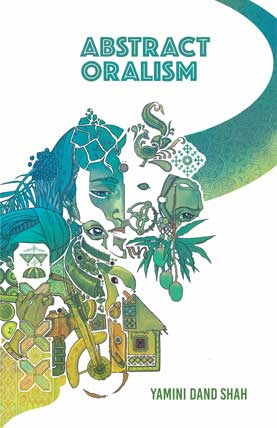
| Author | |
|---|---|
| Imprint | |
| Language | |
| Edition | |
| Pages | 116 |
| Binding |
About the Book
Yamini Dand Shah, with this new book Abstract Oralism, captures both precisely and remarkably the mysterious and elusive world of the Kachchh of Western Gujarat. Her metaphors and similes transport the reader towards this ancient terrain where Indus Valley peoples once flourished. Conceptually advanced and sophisticated, the poetry of this book causes us to reconsider our place in the world: in the light of the author’s extraordinary perception that translates earthly experience into a uniquely beautiful expression of the human condition.
-KEVIN MCGRATH, Poet Laureate, Harvard University
In the ‘Abstract Oralism’, Yamini reveals the beguiling mythic and mimetic history of the dangerously luminous, sensuous, and ephemeral beauty of the desert of Rann of Kachchh leaving us astonished and redeemed at once. ‘Sifting through soiled pages of an anti-modern, abridged dictionary’ of memories, she weaves embroidered tales of palaeolithic biographies of forgotten people in an experimental genre of speech-therapy with fierce emotional power. By turns poignant, playful and ironic, Yamini’s deceptively layered linguistic dreamscapes break new ground in experiencing hallucinatory minimalism in poetry. A mesmerizing debut!
-ASHWANI KUMAR, Poet, Writer and Public Policy Researcher
Related products
-

Variations on Silence
$16About the Book
Throughout Variations on Silence, Nadia Mifsud draws us into intimate scenes and gestures,
as if overhearing lovers mid-conversation. The central figure – almost mythic in scale – is
silence itself, which Mifsud imbues with weight, texture, physical presence. Silence shelters,
stirs, shakes, unwinds, “tastes / of red soil and conifer.” Miriam Calleja’s translation conveys
the ache and longing of that silence with a sensual clarity rare in English. A fabulous book.
– John Wall Barger, The Elephant of SilenceAs Dante said, love is what moves the sun and the other stars – but it is also what flows
through all things, binding them together. This is what breathes in the silences – namely, in
the poems – of Nadia Mifsud : a listening rooted in love, which through love transforms and
reintegrates lovers into the cosmos, restoring the world to something deeply connected to
our humanity. Calleja’s admirable translation – herself a poet – captures this dynamic with
striking clarity and preserves it as the central energy of the work. The encounter between
these two poets ultimately offers us a book of poetry, not merely a book of poems – I repeat:
a cohesive and coherent work, held together by a vision both profound and vast. Ovid’s
Metamorphoses, Rilke’s Duino Elegies… The poetry found in this book is capable of
traversing time and resisting it, of crossing space to bind us – irrevocably – to this cosmos,
and in that bond, to reveal the secret of life.– Pietro Federico, Most of the Stars
Every verb in Nadia Mifsud's work shimmers, echoes, and rappels down the cliffside of a
stanza. Valences expand through repetition; "waves like jaws" locate the oceanic motion. One physically hears and feels the island of Malta in the tension between the isolation,
refrain, and the sea returning to shore, empty-handed. Miriam Calleja's attentive translation brings these affects and "sea-scented places" into English without forsaking the resonances and echoes of "cockleshells" past. Variations on Silence touches the hem where displacement circles the idea of place and results in lyric. The mode is modern; the echoes are ancient; the book is irresistible.– Alina Stefanescu, My Heresies
-

All that I Wanna Do (English)
$16About Book
Dear Sanjeev
I read your poem yesterday ( last evening). Globalisation, and the consequent private Americanisation, corporatisation, computers, mobiles, mall culture and the decline of humanity in every aspect of life is your concern, and mine too.
That you and I have felt that comes with this new kind of life, and the regret that we feel because we cannot deter this decline or escape from it, the sarcastic presentation of the never-ending story of our contemporary miseries appear in your in the poem one after another; and interestingly (your) style neither accepts any poetic form nor it is written in any poetic language, and just as you were exhausted while carving a new definition of poetry, I was exhausted while reading your poem – this is what precisely I want to tell you by writing this exhausting second sentence.
What you have expressed in this poem is the philosophy of this new way of life.
Of course, I think it’s significant that while presenting this philosophy afresh, you haven’t pretended that you are a philosopher!
Yours
Hemant Divate
August 28, 2004
-
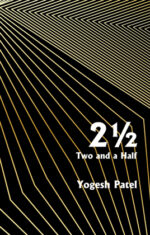
Two and a Half
$16About the Book
Yogesh Patel's poems in "2½" are “sparks of fire”, igniting language into flames of inspiration in a world that fails us, but only if we permit it. Patel magnifies the
humanitarian failures in our world society with poetry of vision that is at once daring and profoundly humane. These are tales of hopes…and lost dreams, rising out of the simmering ash of society's arrested conscience, into the healing blaze of universal truths. One cannot fail to be inspired by the power of compassion in these poems.
– James Ragan, author of ‘The Hunger Wall’ and ‘The Chanter’s Reed’ and
recipient of a Poetry Society of America citation and Swan Foundation Humanitarian
Award==============
These poems are filled with recurring potent images of place and personal histories which successfully invite the reader into intimate spaces. Those spaces include everything from socks to shaving brush but also bravely address disturbing and distressing subject matter. The violence at the heart of this collection is never expressed directly but infuses the poetry, so that the reader is left shaken and thoughtful.
– Maura Dooley, Judge’s comment, Aryamati Prize 2023
-
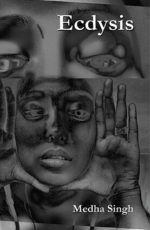
Ecdysis
$16About the Book
After reading the book, one is left with a haunting feeling of something that cannot be revived but lived only through the traces that it leaves in the mind. The poet dives deep into the labyrinths of time to fish out moments that are close to her.
Details that would otherwise be overlooked take on a life of their own and narrate their stories for those who are willing to listen. Medha Singh’s poems demand the reader to not be a mute spectator but feel these snippets of memories as much as they yearn to share. Powerful imagery and the attempt to capture them through words has been done beautifully. – Semeen Ali
For Medha Singh, the poem is often a subterfuge for story; the desire to be a poet is a circularity of purpose; and poetry itself is the beginning and end of trust. Prickling in all directions, uneven, at times unsteady, she chases “itinerant darkness”, achieves rare moments of equanimity, even grace. Mundane reality is a fitting anti-climax, closure an escape.
-
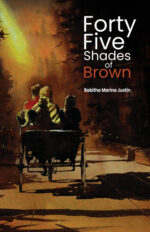
Forty Five Shades of Brown
$16About the Book
Babitha Marina Justin’s poems, woven around self, nature, and body, have an organic architecture, gothic or temple-like, with metaphors working like sculpted images or murals around a central experience. They are honest, at times confessional, often with memories from childhood and adolescence for their raw materials; but they do not shy away from natural calamities and existential crises. Babitha's poems are at once deeply Indian and instinctively feminine in their deployment of images and the organization of experiences.
– K SatchidanandanBabitha Marina Justin has a distinct voice that is passionately lyrical and personal to the point of abandon, and in these COVID times, poetry too has also taken a Corona-Shaped turn. Her world is not only herself, but her neighbourhood, and the larger country which she peppers with a persistent historical awareness, of the Muziris and the Jews. She celebrates their joys and mourns the murky, screaming out the lurking fury in her unique verses.
– Sivakami Velliangiri -
Mapping Gondwana
$16About the Book
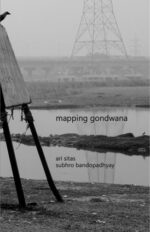
I was moved by the ways in which, at key moments in the dialogue, rhythms shift, and instead of call-response between the poems, we go into each poet’s memory – a call-response between present and past. As they traversed back and forth between private parallel hum – after all, hum is “we” in Hindi – and direct synapse, I loved how freely they responded to both inner reverie and external stimuli. In some of Ari’s poems it felt like he was revisiting earlier trips to India – so that the duet was not restricted to what has just been received but what has always been residual – suggesting collaboration as a pretext – for return? Ari’s riverine contemplations counterpoint Subhro’s archetypal majhi (the boatman) made unmetaphorical. From Tagore’s golden boat to Subhro’s carbon kayak, what rapids have been crossed?
—Sampurna Chattarji
-

Vital Signs
$16About The Book
What happens when you pay attention to which foot leads – when you walk? Or when we really attend to the pleasures of eating, or of a changing sky? What if we realised that paradise is found all around us – Shangri La behind bus stops?
Amlanjyoti Goswami’s poetry is full of these Vital Signs, these details of wonder. Stringing words on a high wire, his is a rare ability to pause time, so we can look, really look, and live. Even the act of repairing a shoe can be meditative and philosophical in his hands. And within the glimpses of grand ideas there is a humility, a reminder that life is there to be felt, touched, lived, in the quietest of moments.
The laureate of ‘the idea of forever, inside an instant’, Amlan’s poetry carries within it, that most unfashionable of qualities – a sense of grace – but also the quiet wisdom that a life is a series of sensations that become memories. He shows us how the mythic can be ordinary, and how the ordinary becomes mythic. –Rishi Dastidar
-
Only the Forest Knows
$20About the Book
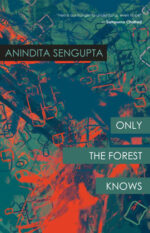
“Wings sense what they must”. And poets too. In her third poetry collection, Anindita Sengupta receives and transmits the hues of a planet mad with want, fear, breakdown. At the heart of a maelstrom of (in)humanity and conflagration, dispossession and disease, her poems bite and rage and mourn. From forage fish to polar bears, she is enmeshed and implicated. With her, we sense the natural world’s mysteries as apprehensible, but “not teachable”. In these poems, breath is the seam that will rip and tear; pain the only climate we can count on. As we embrace deception and vulnerability, we coil in and out of the quieter spaces we contain and are contained by. Hers is our hunger to understand, even hope, so that we might begin again to believe in “small miracles”, to persist, like the algae, “in a world without light.”
– Sampurna Chattarji
Anindita Sengupta asks: “How to speak of violence without /repeating it. What language? What tone? What / memory?” Throughout this coruscating collection, her fluid and inventive poiesis attempts to answer these questions, weaving contingent and deeply human meanings out of personal and collective trauma. Only the Forest Knows is a profoundly accomplished, intelligent work. Sengupta creates an urgent, sensual language that speaks out of the raw contradictions and anguish of the present. This is a poetry tempered by fire, loss and sorrow that
yet, as Rilke said, “nevertheless still praises”: a hard-won beauty that is its own hope.—Alison Croggon