

About the Book
अभिधा सुरू असताना ग्लोबलायझेशझेनची प्रक्रिया सुरू झाली होती. आमच्या काही कविता आणि याच दरम्यान स्वतःला आलेलं जगण्याचं नवं भान, ग्लोबलायझेशझेनमुळेमुळे बदललेला भोवताल आणि या सर्वांमुळे उमजलेले लिहिण्याचंही नवीन भान ह्या ‘अभिधा’मधून आम्ही दिलेल्या किंवा आम्ही मिळविलेल्या काही गोष्टी.
१९९९ मध्ये अभिधा नंतर सुरू केलं तेव्हा ग्लोबलायझेशझेनचा परिणाम असलेले साहित्य आम्ही प्रसिद्ध करू असे धोरण होते आणि २०१४ साली अभिधानंतर बंद करेपर्यंत आम्ही ते लावून धरले. ग्लोबलायझेशनंतर जीवनाप्रमाणे साहित्यही बदलत होतं. हा बदल पकडण्याचा, डॉक्युमेण्ट करण्याचा, नवीन साहित्य लोकांपर्यंत पोहोचविण्याचा उद्देश होता. हा अवकाश ग्लोबलायझेशन’नंतर’चा आणि एका अर्थाने ‘अभिधा”नंतरचा’ अवकाश होता. या पुस्तकातून अभिधानंतरमध्ये प्रकाशित झालेल्या निवडक कविता, लेख, मुलाखती आणि संपादकीय देत आहोत. या सर्व लिखाणां मधून ग्लोबलायझेशन आणि डिजिटालायझेशनंतर निरंतर बदलत असलेली भाषा, संस्कृती,आणि जगणं अधोरेखित होतं. मराठीत सध्या लिहिणाऱ्या, वाचणाऱ्या, विचार करणाऱ्या, भाषेची आणि संस्कृतीची चिंता करणाऱ्या आणि भाषेसाठी झगडणाऱ्या लोकांसाठी हे पुस्तक खूप महत्त्वाचा दस्तऐवज ठरू शकेल याची खात्री आहे.
Feeling happy to see great documentation of our work in Marathi from the late nineteen nineties. Abhidhanantar was a major movement in Marathi that self-consciously highlighted the transformation of our society and culture due to the processes of the post-1989 phase of hyper globalisation that has created the world as we understand today. Our generation was at
the cusp of the dying old analogue world that the modernist and identitarian generation of the Cold War period we had inherited, and the emergent new world of digital natives we gave birth to. Our poetry, world view and thinking documents this shift and this was the periodical that provided the platform to express this discourse. It brought together and created not only new voices like Sanjeev Khandekar, Saleel Wagh, Shridhar Tilwe, Hemant Divate, Manya Joshi, Nitin Kulkarni, Mangesh Narayanrao Kale, Arun Kale, Varjesh Solanki and Nitin Rindhe among many
others but also created a new readership in Marathi.
– Sachin Ketkar
Related products
-

All that I Wanna Do (English)
$16About Book
Dear Sanjeev
I read your poem yesterday ( last evening). Globalisation, and the consequent private Americanisation, corporatisation, computers, mobiles, mall culture and the decline of humanity in every aspect of life is your concern, and mine too.
That you and I have felt that comes with this new kind of life, and the regret that we feel because we cannot deter this decline or escape from it, the sarcastic presentation of the never-ending story of our contemporary miseries appear in your in the poem one after another; and interestingly (your) style neither accepts any poetic form nor it is written in any poetic language, and just as you were exhausted while carving a new definition of poetry, I was exhausted while reading your poem – this is what precisely I want to tell you by writing this exhausting second sentence.
What you have expressed in this poem is the philosophy of this new way of life.
Of course, I think it’s significant that while presenting this philosophy afresh, you haven’t pretended that you are a philosopher!
Yours
Hemant Divate
August 28, 2004
-

Folie Á Deux
$18About the Book
Jennifer Robertson’s first book of poems, Folie à Deux, introduces us to an assured and sophisticated new voice in the world of Anglophone poetry in India. Robertson celebrates the sensuousness, the warm flesh of language. Her poems sharpen our awareness of things viscerally experienced, our memories of things held and cherished, our desire to secure forever the ephemeral yet compelling images of photography and cinema. In her handling, the resonance of the breath crafted into sound takes concrete occupancy of its environment, becomes a percussive force; she writes: “I wonder about sound invading space, wounding, astounding space and stories rising like a Phoenix.”
Here is a poet who captivates us, enchants us into spaces that “have two doors and no exit”.
– Ranjit Hoskote, author of Jonahwhale
Jennifer Robertson’s poems invite us to a world of “intimate strangeness” where poetry is “nuts and waywardness” and poets are “hoodlums” who leave behind “delinquencies” as their legacy. Although thickly silted with references to literature, painting and cinema, this is not a world of glibness or slick cultural sophistication. A throbbing vein of disquiet runs through Folie à Deux reminding us of relationships that could lean towards “darkness and magic”; lives lived in “intermission” with fragments spilling over “in the dark, under the seat”; and a self that yearns to drown into “a sunken civilisation”. This is a poetry of crafted surfaces and unexpected trenches, beeping microwaves and buried cities – allusive and “alluvial” all at once. Folie à Deux is a strong, self-assured début.
– Arundhathi Subramaniam, author of Wild Women
Lexically restless, geodesic, and unapologetically omnivorous, Jennifer Robertson’s Folie à Deux is a dialectic that considers the fulcra of observance and animacy, liberation and stagnancy, tranquility and obsession. Robertson’s poetry applies a painterly heat to our bodies, and readers to scratch at persona, and to map a self through the historical detritus of art and signs. What disturbs me most about this book is that, ravenously, Robertson “reinvents time travel”.
– Jhani Randhawa, author of Time Regime
-
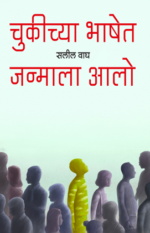
Chukichya Bhashet Janmala Aalo
$20About the Book
Saleel Wagh’s poetry represents a "post-nineties" (Post 90’s) shift in Marathi literature, characterised by a break from traditional lyricism toward a more fragmented, analytical, and metropolitan sensibility. His work explores the friction between a deeply rooted historical identity and the disorienting acceleration of the modern, globalised world.
1. The Linguistic Crisis: "Born in the Wrong Language" The central theme of Wagh’s work is the concept of linguistic inadequacy, as seen in the title "Chukichya Bhashet Janmala Alo" (I was born in the wrong language).
The Mismatch: This suggests that the inherited Marathi tongue is insufficient to articulate
the hyper-real, digital, and corporate experiences of the 21st century.
A New Idiom: By acknowledging this "wrongness," Wagh creates a space where slang, technical terms, and abstract philosophical inquiries can coexist with standard Marathi.
2. Temporal and Spatial Dislocation Wagh frequently uses imagery associated with time and physics to describe psychologicalstates:
The Mechanical Self: References to the "Minute hand" (Minutekata) and the act
of "jumping" suggest a life lived in increments of high-pressure bursts rather than a
continuous flow.
Hyper-awareness: The phrase "Kanat pran alela" (Life-force gathered in the ears)
depicts a state of modern anxiety and extreme sensory alertness.
Global Scattering: The poet observes that "the world is everywhere" and that the
self—likened to scattered beads—is dispersed across the world (Jagbhar), signalling
the loss of a localised, stable home.
3. Historical vs. Modern Landscape
A striking feature of Wagh's poetry is the juxtaposition of ancient geography with modern
existential dread:
Ancient Markers: By invoking "Bharatvarshe,"
"Jambudvipe," and "Dandakaranye," he places the reader in a vast, mytho-
historical timeline.
The Modern Ghost: Within these sacred spaces, he positions "Saleel
Prete" (Saleel’s ghost/corpse), suggesting that the modern individual exists as a
hollow or spectral figure within their own heritage.
4. The Fragmentation of Thought
Wagh’s imagery often focuses on the breakdown of unity:
The Broken String: He writes of the "string of the mind breaking" (Manachi maal
phutte), leading to a state where thoughts and identities—represented
as "beads"—are lost or scattered.
Sudden Flux: The description of "rafters whirring rapidly" (Sapasap vase phirle)
mirrors the chaotic, shifting architecture of both the modern city and the modern
mind. -
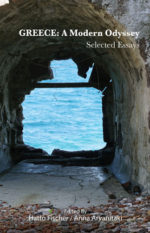
Greece, a modern Odyssey: selected essays
$24About the Book
This outstanding collection of personal essays, sharp analysis, unusual photographs, and poetic reflections focuses on Greece and its people as they found themselves in the eye of a storm that continues to shake Europe and the world. Ranging widely from economics and politics to social and environmental issues, and from cultural and diasporic interactions to literature and the arts, the essays and other materials have been put together in ways that attract, inform, and challenge the reader no matter where she or he may reside. Presenting a roster of distinguished contributors, the editors offer a variety of perspectives, points of information, and allusions, which substantially add to ongoing debates on how individuals and groups may proceed in challenging circumstances. Greece: A Modern Odyssey is being published by Mumbai-based Paperwall Media & Publishing, in memory of the late Hatto Fischer, the German poet and philosopher who lived in Greece and brought this volume together with his wife Anna Arvanitaki.
-
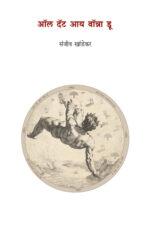
All That I Wanna Do (Marathi)
$16About the Book
Dear Sanjeev,
I read your poem yesterday ( last evening). Globalisation, and the consequent private Americanisation, corporatisation, computers, mobiles, mall culture and the decline of humanity
in every aspect of life is your concern, and mine too. That you and I have felt that comes with this new kind of life, and the regret that we feel because we cannot deter this decline or escape from it, the sarcastic presentation of the never-ending story of our contemporary miseries appear in your in the poem one after another; and interestingly (your) style neither accepts any poetic form nor it is written in any poetic language, and just as you were exhausted while carving a new definition of poetry, I was exhausted while reading your poem – this is what precisely I want to tell you by writing this exhausting second sentence. What you have expressed in this poem is the philosophy of this new way of life. Of course, I think it's significant that while presenting this philosophy afresh, you haven’t pretended that you are a philosopher!
Yours
Hemant Divate
August 28, 2004 -
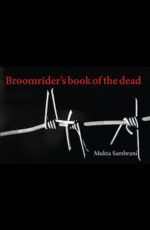
Broomrider’s book of the dead
$26About the Book
Mukta Sambrani’s The woman in this room isn’t lonely is a book of surprising intensity and imagination. Sambrani has a lyricism and fanciful imagination seldom seen in English-language poetry in recent decades. A poem about a man and woman in bed is anything but sentimental. Sambrani’s economy, independence of mind, hard-headedness and irony combine into a rapidly dramatic scene, which within twelve lines becomes grotesquely comic…By now there is a tradition in Indian poems of the coming of poetry as something mysterious. Sambrani’s version is totally unexpected. Bruce King, Modern Indian Poetry in English. Mukta Sambrani’s poems in Broomrider’s book of the dead are notable for their extreme strangeness. The book-length sequence is presented as the working manuscript of its fictional protagonist, Anna Albuquar, whose project is to ‘renegotiate the idea of authorship.’ There are asides, hesitations, false starts, instructions to the reader, and throughout, a steadfast regard for language. Jeet Thayil in Fulcrum and Bloodaxe book of contemporary Indian poets Broomrider’s Book of the Dead…is experimental in every sense… a crowded collage and an eloquent concoction that will make you look up all the references it states or implies…Sambrani said that her protagonist was obsessed with capturing memory “beyond constraints of time and place, beyond decay, illness and the failing of the body. She is obsessed with writing about writing. I am curious about the architecture of our experience. As we move toward a world that is hyper-digitised, our psyches become more and more of an orchestration of fragments of media, sights, sounds, words and visuals. Anna’s writing leans back to lean forward. It captures the history of writing through writing in a world that constructs itself out of fragments of media.Lora Tomas in The Sunday Guardian
-
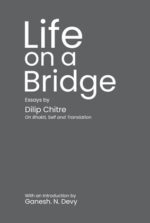
Life on a Bridge
$30About the Book
The essays and transcripts of Dilip Chitre brought together here are valuable in themselves as they offer a commentary on the Indian sense of tradition and the contemporary attitudes to literature. Every piece is of interest in itself. But, their greater worth lies in that they articulate the perspective of one of our most admirable poets on many issues that mattered to him. Taken together, they provide a basis for fathoming his poetry and should help us in making a more nuanced sense of it. Chitre was a fascinating poet, but it is not possible to say that his poetry was easily accessible to most of his readers. Like W. B. Yeats, he weaves in his poems experiences that arise in a given moment (such as the felling of a tree in his father’s house) together with many layers of timeless human quests and anxieties. He brings together silence and euphoria in an imagistic mix that is difficult to name with any precision. It is hence that this
volume of his comments, essays, lectures and other texts should be of importance for the lovers of Dilip Chitre’s literary works.– Ganesh N Devy
-

The Ruined Millionaire: New Selected Poems 2002–2022
$4About the Book
“Mazer, along with his northeastern companions Nikolayev and Kapovich – of the further norths and further easts – make jubilant singing verse as they step through the western wreckage. This must be remembered, say the only poets who’ll matter, so I must write in the ways of memory.” — Glyn Maxwell, from the Preface
“These poems are like trees that contain and protect and conceal themselves from themselves. Each wears a rough coat over the sap, the heart, the rainwater and scars. In so many ways the bark of a tree is a scroll with its messages written out of and into its experience. Mazer’s poems know they are beautiful the way the wooden rills on a tree are elegant, made of history, of romance and pride.” — Fanny Howe
“Ben Mazer is a true inheritor of John Ashbery’s legacy, specifically the Ashbery of Self-Portrait in a Convex Mirror. Like that classic of American poetry, The Ruined Millionaire ironically also suits the contemporary European scene. In translation, Mazer’s new selected poems could just as easily fit on a shelf of the best contemporary Polish or French poetry. Anglophone readers are lucky to have them available to us first.” — John Hennessy
“When Shakespeare meets Ben Mazer at the Mermaid Tavern he will hand Ben this book. ‘Shakespherian’ the Bard will say. ‘And more.’ Another poet at the end of the bar will nod and remark ‘There are No Dry Salvages there.’ Then Will will read ‘Monsieur Barbary Brecht’ to all and they will all be surprised by joy. You will be too when you read these poems: matchless, immortal, and, like all great poetry, unexplainable.” — Joe Green
“‘Start with the rain’: there is a great deal of rain in Ben Mazer’s poetry, often in darkness and whipped by wind. One might speak of a poetic of the torrential, given the irresistible forward sweep of his poems as they move through overlapping territories of memory and history and dream. He advances through the damp corridors of a foundered world, in which the debris (and the vocabulary and the contentions) of centuries has piled up, and the voices of poets and movie actors and a multitude of others re-echo like displaced wraiths. There are constant surprises—cascades of rhyme and apparitions from a history become ghostly, like ‘Caligari, tortured in oblong angles, / beer garden, mental institute, who mangles / memory’—but no matter how allusive or wildly improvisational, no matter how extraordinarily profuse in their range of reference, the lines are never digressive. The past woven into their ‘deep syntax / of auditory visuality’ is a living past: they exist in an urgent present, whether ‘driving thus into the heart of pain’ or momentarily perceiving Fred Astaire and Ginger Rogers, in the last reel of Top Hat, ‘looming and large as any of the designs of God.’ Whatever elements become part of this poetry are distilled with sustained intensity into one substance, a music appropriate to ‘that hour / when memory settles / on the evening / darkness its liquid / history of masks.'” — Geoffrey O’Brien“‘In a soup you never know / what you’ll run into next. All the ingredients repeat, / but you encounter some of them for the first time.’ This is the savory gumbo out of which Ben Mazer has made his poems. At times maddeningly elliptical, at times this ‘ellipticality’ is what moves or tickles or interests you most. The editor of Delmore Schwartz, Hart Crane, and John Crowe Ransom (among others) is himself a poet very much worth savoring.” — Lloyd Schwartz, Pulitzer Prize-winning critic and author of Who’s on First? New and Selected Poems.
“What we can’t think to say, what we don’t know how to say, whether of experience cosmic or minute, he says. The white picket fence that is always intense, the little house between the two big ones, what a movie is. His comparisons are wildly accurate but they aren’t really comparisons at all. They come from similar and related as easily as far away and disparate places or thoughts, which is remarkable for its multidimensionality of seeing. His metaphors are never arbitrary or half convincing, but come from the unconscious. And the sounds fit the sense—there are lines to rival Yeats. And he can sustain a long poem without lagging. Only one who feels every nuance, who suffers intense emotions could write such great poems.” — Ruth Lepson
“The year’s most essential book of poetry.” — Michael Londra in SpoKe