| Author | |
|---|---|
| Imprint | |
| Publication Year | 2016 |
| Language | Marathi |
| Edition | 2 |
| Binding | Paperback |
| Pages | 64 |
Bhramistacha Jahirnama
$2
Out of stock
Related products
-
Hieroglyphs
$29About the Book
Hieroglyphs is a translation of Sahitya Akademi Award winning collection in Marathi- Chitralipi by Vasant Abaji Dahake. It has been translated into the English by Rahee Dahake.
-
The Acrobat Of Oblivion
$10About the book
Maximum Security Guilt is a jail built around the soul brick on brick it holds back the free movement of the mind, the simple gesture of the heart. Brick on brick the sinful bricklayer learns the mastery of the engineer, of the painstaking.
-
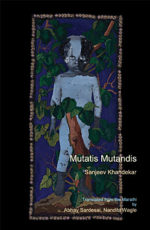
Mutatis Mutandis
$10About the Book
Through sex-dolls and addictions, for whom poetry can be just another narcotic throbbing in your vein. Khandekar’s man has stretched himself to the limits of the Machiavellian primate, modifying his behaviour and absurdum to fit in with the changing patterns of a world spinning out of control on the wheel of progress. Meet the ghost in the machine Sanjeev Khandekar’s poetry grins impishly, then socks you in the eye. It makes you feel horns on your head and inspect your skin for green stripes. Khandekar breaks conventions of belief, language and genre to offer a world with no certainties, where you are just a gob of self-awareness floating in a matrix of virtual reality, mutating every moment to balance your inner needs with social expectations. You are the Mutatis Mutandis Man the human ‘with necessary changes’ carried out the modified man tossed between inscrutable science and enigmatic religious faith, the creature who gropes for love and creativity that may lure you towards self-destruction. Meet Khandekar’s Monster and see if he seems familiar.
Khandekar’s poetry, like his art, is disturbingly unconventional; and Abhay Sardesai and Nandita Wagle’s excellent translation from Marathi now brings it to the English reader.
-Antara Dev Sen -
Mutatis Mutandis
$10About the Book
Through sex-dolls and addictions, for whom poetry can be just another narcotic throbbing in your vein. Khandekar’s man has stretched himself to the limits of the Machiavellian primate, modifying his behaviour and absurdum to fit in with the changing patterns of a world spinning out of control on the wheel of progress. Meet the ghost in the machine Sanjeev Khandekar’s poetry grins impishly, then socks you in the eye. It makes you feel horns on your head and inspect your skin for green stripes. Khandekar breaks conventions of belief, language and genre to offer a world with no certainties, where you are just a gob of self-awareness floating in a matrix of virtual reality, mutating every moment to balance your inner needs with social expectations. You are the Mutatis Mutandis Man the human ‘with necessary changes’ carried out the modified man tossed between inscrutable science and enigmatic religious faith, the creature who gropes for love and creativity that may lure you towards self-destruction. Meet Khandekar’s Monster and see if he seems familiar.
Khandekar’s poetry, like his art, is disturbingly unconventional; and Abhay Sardesai and Nandita Wagle’s excellent translation from Marathi now brings it to the English reader.
-Antara Dev Sen -
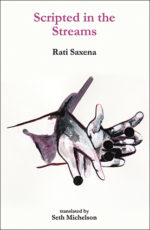
Scripted in the Streams
$12About the Books
There is an intense humanity in these poems by Rati Saxena, a humanity that ennobles all of us who are humble enough to listen. There is an empathy is these poems for all living things – for the spider, for the ant, for the owl – and a similar understanding of all things that may not be alive. -Alan Titley, Professor Emeritus of Modern Irish, University College, Cork It has travelled a long, long way this voice?and we welcome it as we would do a stranger, into the West where despair, decline and decay are seemingly permanent lodgers, Saxena’s lyrics arrive like a fresh breeze. New-born, fresh and smelling of the earth, her poems draw on the well of Indo-European tradition, the intimate links that bind the female psyche and the landscape in all its fecundity. -Dr Michel h’Aodha, University of Limerick Saxena allows for different aeons to melt into each other. She creates a world in which humans interact with insects and animals. We are all of and from the same source. The image of the snake is a powerful one to explain the frustrations of modern women in today’s India. Her vision makes a mockery of the boundaries around our lives and we sail with her through a magical world, coming into contact with the source of life itself. There are echoes of Flann O’ Brien in the delightful poem about the bicycle of her youth. Taboos and rituals will not enslave her and poetry finds its way into the washing on the line and the fire that bakes our daily bread. – Ceaiti Ni Bheildiuin, poet In this selection of the poems of Rati Saxena we are drawn into a world of imagery where deep respect is shown for the low -Brian O Conchubhair, University of Notre Dame, USA
-
-

First Infinities
$12About the Book
Hell, or a state very much like it, does feature in Nambisan’s poetic underworld, which is deep, intricate and enticing. …… – From the Preface by Adil Jussawala Nambisan’s view of humankind is bleak, his view of the possibilities of poetry even bleak