| Author | |
|---|---|
| Imprint | |
| Language | |
| Binding | |
| Edition | |
| Publishing Year | |
| Pages | 172 |
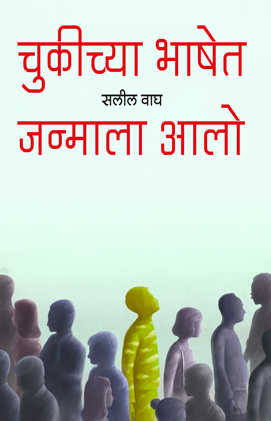
Chukichya Bhashet Janmala Aalo
$20
About the Book
Saleel Wagh’s poetry represents a "post-nineties" (Post 90’s) shift in Marathi literature, characterised by a break from traditional lyricism toward a more fragmented, analytical, and metropolitan sensibility. His work explores the friction between a deeply rooted historical identity and the disorienting acceleration of the modern, globalised world.
1. The Linguistic Crisis: "Born in the Wrong Language" The central theme of Wagh’s work is the concept of linguistic inadequacy, as seen in the title "Chukichya Bhashet Janmala Alo" (I was born in the wrong language).
The Mismatch: This suggests that the inherited Marathi tongue is insufficient to articulate
the hyper-real, digital, and corporate experiences of the 21st century.
A New Idiom: By acknowledging this "wrongness," Wagh creates a space where slang, technical terms, and abstract philosophical inquiries can coexist with standard Marathi.
2. Temporal and Spatial Dislocation Wagh frequently uses imagery associated with time and physics to describe psychological
states:
The Mechanical Self: References to the "Minute hand" (Minutekata) and the act
of "jumping" suggest a life lived in increments of high-pressure bursts rather than a
continuous flow.
Hyper-awareness: The phrase "Kanat pran alela" (Life-force gathered in the ears)
depicts a state of modern anxiety and extreme sensory alertness.
Global Scattering: The poet observes that "the world is everywhere" and that the
self—likened to scattered beads—is dispersed across the world (Jagbhar), signalling
the loss of a localised, stable home.
3. Historical vs. Modern Landscape
A striking feature of Wagh's poetry is the juxtaposition of ancient geography with modern
existential dread:
Ancient Markers: By invoking "Bharatvarshe,"
"Jambudvipe," and "Dandakaranye," he places the reader in a vast, mytho-
historical timeline.
The Modern Ghost: Within these sacred spaces, he positions "Saleel
Prete" (Saleel’s ghost/corpse), suggesting that the modern individual exists as a
hollow or spectral figure within their own heritage.
4. The Fragmentation of Thought
Wagh’s imagery often focuses on the breakdown of unity:
The Broken String: He writes of the "string of the mind breaking" (Manachi maal
phutte), leading to a state where thoughts and identities—represented
as "beads"—are lost or scattered.
Sudden Flux: The description of "rafters whirring rapidly" (Sapasap vase phirle)
mirrors the chaotic, shifting architecture of both the modern city and the modern
mind.
Related products
-
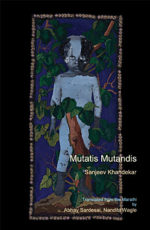
Mutatis Mutandis
$10About the Book
Through sex-dolls and addictions, for whom poetry can be just another narcotic throbbing in your vein. Khandekar’s man has stretched himself to the limits of the Machiavellian primate, modifying his behaviour and absurdum to fit in with the changing patterns of a world spinning out of control on the wheel of progress. Meet the ghost in the machine Sanjeev Khandekar’s poetry grins impishly, then socks you in the eye. It makes you feel horns on your head and inspect your skin for green stripes. Khandekar breaks conventions of belief, language and genre to offer a world with no certainties, where you are just a gob of self-awareness floating in a matrix of virtual reality, mutating every moment to balance your inner needs with social expectations. You are the Mutatis Mutandis Man the human ‘with necessary changes’ carried out the modified man tossed between inscrutable science and enigmatic religious faith, the creature who gropes for love and creativity that may lure you towards self-destruction. Meet Khandekar’s Monster and see if he seems familiar.
Khandekar’s poetry, like his art, is disturbingly unconventional; and Abhay Sardesai and Nandita Wagle’s excellent translation from Marathi now brings it to the English reader.
-Antara Dev Sen -
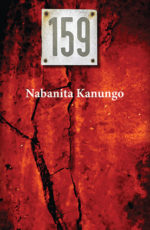
159
$12About the Book
Nabanita Kanungo’s collection is simultaneously an elegy and a victory song. A documentation of the heartbreaks that have plagued our subcontinent for the past century or so, her poems re-define the lyric form, chronicling the unfolding of a personal self framed by larger political events. Here, history appears as a long, continuous saga of violence, in which Partition memories remain juxtaposed within the everyday lived realities and violences of neoliberal Indian cities. With this collection, Kanungo provides a ghostly account of quotidian survival?stories that remain forever out of official histories?and re-defines the meaning of Anglophone India political poetry of contemporary times.Nabanita Kanungo’s poems ache with an awareness of how poetry cannot truly evoke anything but absence, of how ‘It rains and words say nothing’; ‘Only memory is green’. In this tragedy, Kanungo finds the only solace available to the poet: a luminous quality in the every day, the ‘Mirror where things are simply written with light’. These poems work in the liminal spaces of the world and of the self, between the present moment and its turning into memory, between words and rain.
-

Zingonia Zingonechya Kavita
$10About the Book
b.1967 is an internationally well-known Marathi poet, editor, publisher and translator. His published works include Chautishiparyantchya Kavita Poems Till Thirty-Four, Thambtach Yet Nahi Just Cant Stop and Ya Roommadhye Aale Ki Life Suru Hote The Moment You Enter This Room, Life Begins. His poems have been translated into English, French, Spanish, German, Urdu, Arabic, Gujarati, Bengali, Hindi, Oriya, Tamil, Telugu, Kannada and Malayalam. The celebrated poet and translator Dilip Chitre translated Chautishiparyantchya Kavita into English and titled the book Virus Alert which then has been translated into Spanish-Alarma De Virus by Zingonia Zingone and in Irish as Folireamh Vris by Gabriel Rosenstock.
-

First Infinities
$12About the Book
Hell, or a state very much like it, does feature in Nambisan’s poetic underworld, which is deep, intricate and enticing. …… – From the Preface by Adil Jussawala Nambisan’s view of humankind is bleak, his view of the possibilities of poetry even bleak
-
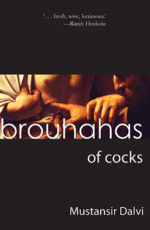
Brouhahas Of Cocks
$15About the Book
Hardback awakening The air is thick, and has revived my books, anticipating the first spell of a Bombay monsoon. Ambient moisture has slaked pages that shuffle and twist, arise to a wakefulness, unleaving. Feeling the discomfort of nearness,
-

Frazil
$16About the Book
Menka Shivdasani’s poetry is both original and strikingly unusual, not just her tangential way of putting things across, but also how thought process and imagination run away with the poem, and make it exciting. An experience is translated into another experience and then gets mixed with fancy in a juice blender. Chopping lettuce, she’ll be assailed by visions—burning bride, politician, a ‘wounded Hiroshima’, and finally a finger-chopping Nazi. A poem about separation will end with her handling ‘alien porcelain’ at a tea party. For over three decades the excitement she brings to her fine poetry has never deserted her.