
-
My Home is Dissent
$16About the Book
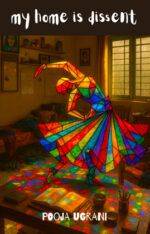
Pooja Ugrani listens to nature amidst the thump-thump-thump of construction. Forest fires, dragons and rabbits materialise without warning, a series of ambushes that test the city-dweller’s hard-won survival instincts. Words stick their tongues out, cheekily unfamiliar. Ugrani participates physically in the making of her poems, not only through photos, but also through the palpability of the body’s smears, spills and stains. Here is a poet testing her wings, where dissension may well be a heartbeat away from dissection.
—SAMPURNA CHATTARJI, author of Unmappable Moves and Space Gulliver.Pooja’s poems do what women’s poetry has been doing forever. They shut their mouth so tight that the stifled words ricochet back in and make their hearts thud like a talking drum. And they sign it off with today's date. – MAITHREYI KARNOOR, novelist and author.
Pooja Ugrani constructs poems as one might build a home; brick by tender brick, with the mortar of memory, desire, and defiance. Her verse moves fluidly between the everyday and the elemental, where the domestic is never mundane but a site of quiet resistance and reimagining. This world of words measures the dimensions of love, labour, and loss through the delicate instruments of memory, architecture, and motherhood. She writes of labour, love, and dissent as acts of design – as deliberate gestures that hold the self together.
Ugrani’s dissent is luminous, not loud. It hums through acts of nurture, through refusal, through the courage to remain soft in a world that demands armour. Formally supple and sensorial, cerebral and sensuous, her poems fold the architectural and the emotional into one continuum.
– SRIVIDYA SIVAKUMAR, poet. -
Two and a Half
$16About the Book
Yogesh Patel's poems in "2½" are “sparks of fire”, igniting language into flames of inspiration in a world that fails us, but only if we permit it. Patel magnifies the
humanitarian failures in our world society with poetry of vision that is at once daring and profoundly humane. These are tales of hopes…and lost dreams, rising out of the simmering ash of society's arrested conscience, into the healing blaze of universal truths. One cannot fail to be inspired by the power of compassion in these poems.
– James Ragan, author of ‘The Hunger Wall’ and ‘The Chanter’s Reed’ and
recipient of a Poetry Society of America citation and Swan Foundation Humanitarian
Award==============
These poems are filled with recurring potent images of place and personal histories which successfully invite the reader into intimate spaces. Those spaces include everything from socks to shaving brush but also bravely address disturbing and distressing subject matter. The violence at the heart of this collection is never expressed directly but infuses the poetry, so that the reader is left shaken and thoughtful.
– Maura Dooley, Judge’s comment, Aryamati Prize 2023
-
Maniyachi Duniya
$16About the Book
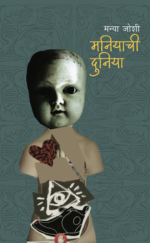
Maniyachi Duniya is a place where every poem begins in one register and slips, almost mischievously, into another. A phrase might start in the noise of a Mumbai street, brush against an old folk cadence, then suddenly tilt into the rhythm of an Instagram reel or a meme you half-remember. This referential drift isn’t random; it is the way we actually live now, surrounded by isms, social-justice vocabularies, shifting identities, and constant tech updates that rewrite our attention every few hours. Each poem absorbs that swirl and lets it tilt toward something unexpected, sometimes absurd, but always resonant and strangely tender. And though the work is laced with wit, it’s never sarcasm. Its irony is gentler. It is the kind that knows its own limits, that stays aware of the fragility of meaning, that smiles at the world without dismissing it. The delight of these poems comes from how they recognize the chaos of the present moment and still manage to turn each reference, each tonal slip, into a small, generous surprise.
-
Chukichya Bhashet Janmala Aalo
$20About the Book
Saleel Wagh’s poetry represents a "post-nineties" (Post 90’s) shift in Marathi literature, characterised by a break from traditional lyricism toward a more fragmented, analytical, and metropolitan sensibility. His work explores the friction between a deeply rooted historical identity and the disorienting acceleration of the modern, globalised world.
1. The Linguistic Crisis: "Born in the Wrong Language" The central theme of Wagh’s work is the concept of linguistic inadequacy, as seen in the title "Chukichya Bhashet Janmala Alo" (I was born in the wrong language).
The Mismatch: This suggests that the inherited Marathi tongue is insufficient to articulate
the hyper-real, digital, and corporate experiences of the 21st century.
A New Idiom: By acknowledging this "wrongness," Wagh creates a space where slang, technical terms, and abstract philosophical inquiries can coexist with standard Marathi.
2. Temporal and Spatial Dislocation Wagh frequently uses imagery associated with time and physics to describe psychologicalstates:
The Mechanical Self: References to the "Minute hand" (Minutekata) and the act
of "jumping" suggest a life lived in increments of high-pressure bursts rather than a
continuous flow.
Hyper-awareness: The phrase "Kanat pran alela" (Life-force gathered in the ears)
depicts a state of modern anxiety and extreme sensory alertness.
Global Scattering: The poet observes that "the world is everywhere" and that the
self—likened to scattered beads—is dispersed across the world (Jagbhar), signalling
the loss of a localised, stable home.
3. Historical vs. Modern Landscape
A striking feature of Wagh's poetry is the juxtaposition of ancient geography with modern
existential dread:
Ancient Markers: By invoking "Bharatvarshe,"
"Jambudvipe," and "Dandakaranye," he places the reader in a vast, mytho-
historical timeline.
The Modern Ghost: Within these sacred spaces, he positions "Saleel
Prete" (Saleel’s ghost/corpse), suggesting that the modern individual exists as a
hollow or spectral figure within their own heritage.
4. The Fragmentation of Thought
Wagh’s imagery often focuses on the breakdown of unity:
The Broken String: He writes of the "string of the mind breaking" (Manachi maal
phutte), leading to a state where thoughts and identities—represented
as "beads"—are lost or scattered.
Sudden Flux: The description of "rafters whirring rapidly" (Sapasap vase phirle)
mirrors the chaotic, shifting architecture of both the modern city and the modern
mind. -
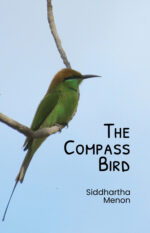
The Compass Bird
$15About the Book
Observant and meditative, lit with gentle whimsy, Siddhartha Menon’s work on the animal world leads us from ornithology to ontology, detail to dazzling insight, in a wingbeat. Here is a book in which the reverie of snails, the ‘mynahness’ of mynahs, the unhurried gaze of nilgai, becomes a way to reflect on all the eternal questions—time, belonging, love, purpose, a world ‘stained with stillness’, in which ‘those who attend have the last word’. One of the most delightful new books of poetry I have read this year.
– Arundhathi Subramaniam
-
Obsessed with Life
$10About the Book
“Mozetič’s verse conjures a distinctly gay way of looking at the world. It is both placid and paranoid, opening the world into paper-thin layers of sex, loneness and non-disingenuous self-reflection. His lyric has a remarkable flow, his language is persuasively simple, and his tone is forthright, all of which give the shattered heart at the core of this book a strange magnetic force.”
– Akhil Katyal, poet, translator, scholar and queer activist
-
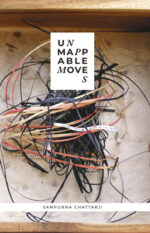
Unmappable Moves
$20About the Book
Reading Unmappable Moves, I had the strangest sensation of time expanding and closing in. These are taut, enigmatic poems—lightning flashes with bright, insistent heartbeats.—TISHANI DOSHILethal tales of sex and death that left me pining for more of Sampurna Chattarji’s mysterious lyric inventions.—JEET THAYIL -
UNLIKELY JOURNEY
$12About the Book
As happens on all trips, in the pages of this book we find unforeseen questions and unexpected landscapes. These verses are transparent because they speak to us not about what is intuited or remembered but what is seen while trying to establish order, specify limits, and vanquish shadows.
-
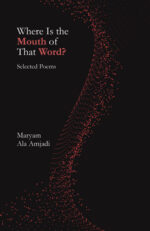
Where Is the Mouth of That Word?
$16About the Book
I breathed. I looked up. I saw her standing in the line of fire, “simply standing/on the last line of
this page”, asking, as she looked me in the eye, “Where are you reading from?”And that, dear readers, who are about to encounter Maryam’s poems for the first time, is the
question.
You can Google her, you can hear her speak 1 , you can explore her intersecting engagements as an essayist, translator, and academic.
But first, you can find her here, as I did, in a selection of her poems – from early to later, from the spoken word to the “vocal infection of the page”, from rant to reflection, plea to command.
You could, in obeyance, “Turn the page, and leave!”
You could be sentenced
to an expired word:
(Silence)You could hear the tanin (echo) of Sepehri’s hich (nothingness) reverberating at the same frequency with which you see Dali’s ‘The Echo of the Void’ hovering in your line of vision.
You could, and you will.
For now, all that matters is knowing (asking!) where you read from.
And as for the title we eventually chose – where is the mouth of that word?
Wherever there is one – fearless enough to speak it.– Sampurna Chattarji