| Author | |
|---|---|
| Imprint | |
| Language | |
| Edition | |
| Publication Year | 2012 |
| Binding | |
| Pages | 82 |

$12
Out of stock
About the Book
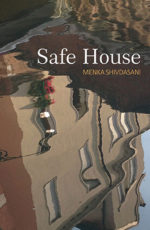
At the Seminar The door creaks like the wail of some small animal. I am terrified: the present speaker like the ones before him will make me aware of how little I know. Both of us open our mouths at the same time, he to read his paper, I to yawn.
Related products
-
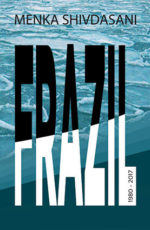
Frazil
$16About the Book
Menka Shivdasani’s poetry is both original and strikingly unusual, not just her tangential way of putting things across, but also how thought process and imagination run away with the poem, and make it exciting. An experience is translated into another experience and then gets mixed with fancy in a juice blender. Chopping lettuce, she’ll be assailed by visions—burning bride, politician, a ‘wounded Hiroshima’, and finally a finger-chopping Nazi. A poem about separation will end with her handling ‘alien porcelain’ at a tea party. For over three decades the excitement she brings to her fine poetry has never deserted her.
-
-
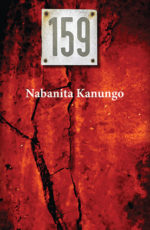
159
$12About the Book
Nabanita Kanungo’s collection is simultaneously an elegy and a victory song. A documentation of the heartbreaks that have plagued our subcontinent for the past century or so, her poems re-define the lyric form, chronicling the unfolding of a personal self framed by larger political events. Here, history appears as a long, continuous saga of violence, in which Partition memories remain juxtaposed within the everyday lived realities and violences of neoliberal Indian cities. With this collection, Kanungo provides a ghostly account of quotidian survival?stories that remain forever out of official histories?and re-defines the meaning of Anglophone India political poetry of contemporary times.Nabanita Kanungo’s poems ache with an awareness of how poetry cannot truly evoke anything but absence, of how ‘It rains and words say nothing’; ‘Only memory is green’. In this tragedy, Kanungo finds the only solace available to the poet: a luminous quality in the every day, the ‘Mirror where things are simply written with light’. These poems work in the liminal spaces of the world and of the self, between the present moment and its turning into memory, between words and rain.
-
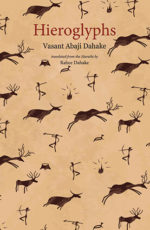
Hieroglyphs
$29About the Book
Hieroglyphs is a translation of Sahitya Akademi Award winning collection in Marathi- Chitralipi by Vasant Abaji Dahake. It has been translated into the English by Rahee Dahake.
-
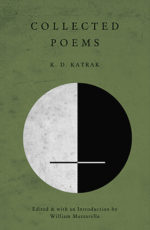
Collected Poems
$20About the Book
Adman, householder, mystic, public intellectual and ashram devotee, Kersy Katrak (1936-2007) has never quite received his due as a poet. Katrak’s ‘lush, provocative, and very readable’verse has, with its rare but persistent appearance in anthologies of Indian poetry in English, remained in a curious way at once unforgotten and unrecognized. This book aims, at long last,to remedy this state of affairs. It is the very first comprehensive collection of Katrak’s poetic work, most of it long out of print,some of it previously published only in hard-to-find periodicals. Katrak’s poetry resonates powerfully with Wallace Steven’s observation that ‘It is equal to living in a tragic land, To live in a tragic time’. His concerns remain,palpably,our concerns: a search for the everyday alchemy that might translate the visceral potentials of collective life into generative forms of belonging. This problem of the relation between inner energies and outer forms is at the core of Katrak’s work as a poet and a mystic. And it is what binds his esoteric commitments to his career in advertising. The anthropologist William Mazzarella’s critical introduction to the present volume is the first substantive exploration of these connections in Katrak’s life and work.
-

Zingonia Zingonechya Kavita
$10About the Book
b.1967 is an internationally well-known Marathi poet, editor, publisher and translator. His published works include Chautishiparyantchya Kavita Poems Till Thirty-Four, Thambtach Yet Nahi Just Cant Stop and Ya Roommadhye Aale Ki Life Suru Hote The Moment You Enter This Room, Life Begins. His poems have been translated into English, French, Spanish, German, Urdu, Arabic, Gujarati, Bengali, Hindi, Oriya, Tamil, Telugu, Kannada and Malayalam. The celebrated poet and translator Dilip Chitre translated Chautishiparyantchya Kavita into English and titled the book Virus Alert which then has been translated into Spanish-Alarma De Virus by Zingonia Zingone and in Irish as Folireamh Vris by Gabriel Rosenstock.