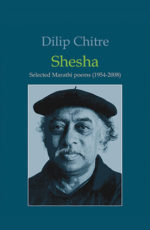
| Author | |
|---|---|
| Imprint | |
| Language | |
| Edition | |
| Publication Year | 2012 |
| Binding | |
| Pages | 82 |

$12
Out of stock
About the Book
At the Seminar The door creaks like the wail of some small animal. I am terrified: the present speaker like the ones before him will make me aware of how little I know. Both of us open our mouths at the same time, he to read his paper, I to yawn.
Related products
-

First Infinities
$12About the Book
Hell, or a state very much like it, does feature in Nambisan’s poetic underworld, which is deep, intricate and enticing. …… – From the Preface by Adil Jussawala Nambisan’s view of humankind is bleak, his view of the possibilities of poetry even bleak
-
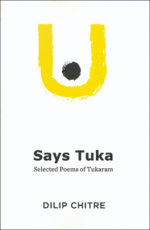
Says Tuka-Selected poems of Tukaram
$30About the Book
Tukaram was born in 1608 and vanished without a trace in 1650. what little we know of his life is a reconstruction from his own autobiographical poems, the contemporary poetess Bahinabai’s memoirs in verse, and the later biographer of Marathi poet-saints, Mahipati’s account. The rest is all folklore, though it cannot be dismissed on those grounds alone. Modern scholars such as the late V. S. Bendre have made arduous efforts to collate evidence from disparate contemporary sources to establish a well-researched biography of Tukaram. But even this is largely conjectural.
Tukaram is therefore not only the last great Bhakti poet in Marathi but he is also the first truly modern Marathi poet in terms of temper and thematic choice, technique and vision. He is certainly the most vital link between medieval and modern Marathi poetry. Tukaram’s stature in Marathi literature is comparable to that of Shakespeare in English or Goethe in German. He could be called the quintessential Marathi poet reflecting the genius of the language as well as its characteristic literary culture. There is no other Marathi writer who has so deeply and widely influenced Marathi literary culture since. Tukaram’s poetry has shaped the Marathi language, as it is spoken by 70 million people today and not just the literary language. Perhaps one should compare his influence with that of the King James version of the Bible upon speakers of the English language. For Tukaram’s poetry is also used by illiterate millions to voice their prayers or to express their love of God.
-

Grab your heart & follow me
$3About the Book
“In my wonderland, there are only beginnings, ‘there is no end’. Plunge into this book of?poems by Claus Ankersen where cat-gods rule, babies are born with stargates for eyes, kisses are catalogued and the 12th pen writes of celebratory sins. Expand the eternity of now. Be nomad, tiger, ‘soulhuntress.’ Head-dive into the mysteries of the world. Dance
-
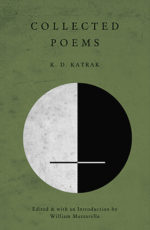
Collected Poems
$20About the Book
Adman, householder, mystic, public intellectual and ashram devotee, Kersy Katrak (1936-2007) has never quite received his due as a poet. Katrak’s ‘lush, provocative, and very readable’verse has, with its rare but persistent appearance in anthologies of Indian poetry in English, remained in a curious way at once unforgotten and unrecognized. This book aims, at long last,to remedy this state of affairs. It is the very first comprehensive collection of Katrak’s poetic work, most of it long out of print,some of it previously published only in hard-to-find periodicals. Katrak’s poetry resonates powerfully with Wallace Steven’s observation that ‘It is equal to living in a tragic land, To live in a tragic time’. His concerns remain,palpably,our concerns: a search for the everyday alchemy that might translate the visceral potentials of collective life into generative forms of belonging. This problem of the relation between inner energies and outer forms is at the core of Katrak’s work as a poet and a mystic. And it is what binds his esoteric commitments to his career in advertising. The anthropologist William Mazzarella’s critical introduction to the present volume is the first substantive exploration of these connections in Katrak’s life and work.
-
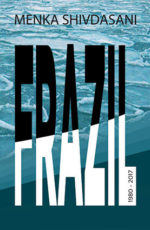
Frazil
$16About the Book
Menka Shivdasani’s poetry is both original and strikingly unusual, not just her tangential way of putting things across, but also how thought process and imagination run away with the poem, and make it exciting. An experience is translated into another experience and then gets mixed with fancy in a juice blender. Chopping lettuce, she’ll be assailed by visions—burning bride, politician, a ‘wounded Hiroshima’, and finally a finger-chopping Nazi. A poem about separation will end with her handling ‘alien porcelain’ at a tea party. For over three decades the excitement she brings to her fine poetry has never deserted her.
-
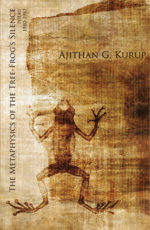
The Metaphysics of the Tree-Frog’s Silence
$12About the Book
It is our loss that we did not know Ajithan Kurup’s work when he was alive, and we did not celebrate his brave and lonely project: to render the unsayable into language. He cannot be imitated or replaced, only admired.- Jeet Thayil
To enter Ajithan G. Kurup’s poetic world is to risk, in the words of his title poem, dancing “headlong down precipices.” It’s rare to find a contemporary poet who dares near-unattainable heights and fearful depths on dancing words – words that may sometimes seem far-fetched or invented but which, in fact, are inspired variants or archaic forms of those more usually used: “sempstress” instead of “seamstress”, “enow” instead of “enough”, “trode” instead of “trod”.-ADIL JUSSAWALLA
-

Durable Transit
$22About the Book
Ravi Shankar’s poems are immortal in the flesh, finding in The life of the mind its interpretations, its instrumentality. The surpassing, transient, lyrical moment; and in the life of the World’s body the permanent, unflinching presence of thought, Unconfined by time and space. They are the verbal artifacts of a Singular, many-sided, and distinguished consciousness.Pulitzer Prize winner Vijay Seshadri Engorged with image, thick, viscous and churning, Ravi Shankar’s Poems have the density of mercury as well as its fluidity and Mobility…The energy is visceral. The language is restless, hungry For surprise, the register swinging between the formal and the Demotic (both American and Indian). Underlying this is an Almost voluptuous need to embrace myth, history, metaphysics And pop culture, and bring all of it into a single book, and Sometimes a single poem. This is matched by an alertness to form with references ranging from the Bop to the pada — making for A playful, stylistically supple poetry. – Arundhathi Subramaniam Ravi Shankar’s poems have a fine-tuned sense of form, a rare Delight in language. Through wit and abstraction, they reveal a Metaphysics of longing, binding us to the elements of our moving World. – Meena Alexander
Ravi Shankar is truly, now, one of America’s finest younger poets.-Dick Allen