About the Book
The essays and transcripts of Dilip Chitre brought together here are valuable in themselves as they offer a commentary on the Indian sense of tradition and the contemporary attitudes to literature. Every piece is of interest in itself. But, their greater worth lies in that they articulate the perspective of one of our most admirable poets on many issues that mattered to him. Taken together, they provide a basis for fathoming his poetry and should help us in making a more nuanced sense of it. Chitre was a fascinating poet, but it is not possible to say that his poetry was easily accessible to most of his readers. Like W. B. Yeats, he weaves in his poems experiences that arise in a given moment (such as the felling of a tree in his father’s house) together with many layers of timeless human quests and anxieties. He brings together silence and euphoria in an imagistic mix that is difficult to name with any precision. It is hence that this
volume of his comments, essays, lectures and other texts should be of importance for the lovers of Dilip Chitre’s literary works.
– Ganesh N Devy
Related products
-
Where Is the Mouth of That Word?
$16About the Book
I breathed. I looked up. I saw her standing in the line of fire, “simply standing/on the last line of
this page”, asking, as she looked me in the eye, “Where are you reading from?”And that, dear readers, who are about to encounter Maryam’s poems for the first time, is the
question.
You can Google her, you can hear her speak 1 , you can explore her intersecting engagements as an essayist, translator, and academic.
But first, you can find her here, as I did, in a selection of her poems – from early to later, from the spoken word to the “vocal infection of the page”, from rant to reflection, plea to command.
You could, in obeyance, “Turn the page, and leave!”
You could be sentenced
to an expired word:
(Silence)You could hear the tanin (echo) of Sepehri’s hich (nothingness) reverberating at the same frequency with which you see Dali’s ‘The Echo of the Void’ hovering in your line of vision.
You could, and you will.
For now, all that matters is knowing (asking!) where you read from.
And as for the title we eventually chose – where is the mouth of that word?
Wherever there is one – fearless enough to speak it.– Sampurna Chattarji
-

Three Stories – Jibanananda Das
$10About the Book
Reading Jibanananda Das’s stories is like entering straight into the middle-class Bengali mind with its desire, ambition, morbidity and despair. Through the narratives around three men whose melancholy defines the structure of these three stories, the writer re-examines the concepts of success and failure, desire and fulfillment, love and weariness, ennui and death. While the insights are those of a poet, these stories marked by Jibanananda’s deep involvement with Bengali landscape, cuisine and culture, transcend his lyrical impulse to become proper, if technically innovative, short stories with the touch of a master of the genre. Chandak Chattarji’s English versions have been able to capture the provincial setting and style of the original narratives keeping intact their nuanced psychological implications and larger insights into the human condition.’ – K. Satchidanandan ‘It has been a privilege to discover Das the writer of fiction through Chandak Chattarji’s elegant and sensitive translation of three of the master’s short stories, ‘Chhaya Nat’ (‘Shadow Play’), ‘Gram o Shohorer Galpo’ (‘Tale of City and Village’), and ‘Bilash’ (which retains its original title here).’ – Ranjit Hoskote
-
All That I Wanna Do (Marathi)
$16About the Book
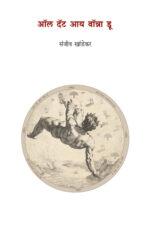
Dear Sanjeev,
I read your poem yesterday ( last evening). Globalisation, and the consequent private Americanisation, corporatisation, computers, mobiles, mall culture and the decline of humanity
in every aspect of life is your concern, and mine too. That you and I have felt that comes with this new kind of life, and the regret that we feel because we cannot deter this decline or escape from it, the sarcastic presentation of the never-ending story of our contemporary miseries appear in your in the poem one after another; and interestingly (your) style neither accepts any poetic form nor it is written in any poetic language, and just as you were exhausted while carving a new definition of poetry, I was exhausted while reading your poem – this is what precisely I want to tell you by writing this exhausting second sentence. What you have expressed in this poem is the philosophy of this new way of life. Of course, I think it's significant that while presenting this philosophy afresh, you haven’t pretended that you are a philosopher!
Yours
Hemant Divate
August 28, 2004 -
Obsessed with Life
$10About the Book
“Mozetič’s verse conjures a distinctly gay way of looking at the world. It is both placid and paranoid, opening the world into paper-thin layers of sex, loneness and non-disingenuous self-reflection. His lyric has a remarkable flow, his language is persuasively simple, and his tone is forthright, all of which give the shattered heart at the core of this book a strange magnetic force.”
– Akhil Katyal, poet, translator, scholar and queer activist
-
Broomrider’s book of the dead
$26About the Book
Mukta Sambrani’s The woman in this room isn’t lonely is a book of surprising intensity and imagination. Sambrani has a lyricism and fanciful imagination seldom seen in English-language poetry in recent decades. A poem about a man and woman in bed is anything but sentimental. Sambrani’s economy, independence of mind, hard-headedness and irony combine into a rapidly dramatic scene, which within twelve lines becomes grotesquely comic…By now there is a tradition in Indian poems of the coming of poetry as something mysterious. Sambrani’s version is totally unexpected. Bruce King, Modern Indian Poetry in English. Mukta Sambrani’s poems in Broomrider’s book of the dead are notable for their extreme strangeness. The book-length sequence is presented as the working manuscript of its fictional protagonist, Anna Albuquar, whose project is to ‘renegotiate the idea of authorship.’ There are asides, hesitations, false starts, instructions to the reader, and throughout, a steadfast regard for language. Jeet Thayil in Fulcrum and Bloodaxe book of contemporary Indian poets Broomrider’s Book of the Dead…is experimental in every sense… a crowded collage and an eloquent concoction that will make you look up all the references it states or implies…Sambrani said that her protagonist was obsessed with capturing memory “beyond constraints of time and place, beyond decay, illness and the failing of the body. She is obsessed with writing about writing. I am curious about the architecture of our experience. As we move toward a world that is hyper-digitised, our psyches become more and more of an orchestration of fragments of media, sights, sounds, words and visuals. Anna’s writing leans back to lean forward. It captures the history of writing through writing in a world that constructs itself out of fragments of media.Lora Tomas in The Sunday Guardian
-

Folie Á Deux
$18About the Book
Jennifer Robertson’s first book of poems, Folie à Deux, introduces us to an assured and sophisticated new voice in the world of Anglophone poetry in India. Robertson celebrates the sensuousness, the warm flesh of language. Her poems sharpen our awareness of things viscerally experienced, our memories of things held and cherished, our desire to secure forever the ephemeral yet compelling images of photography and cinema. In her handling, the resonance of the breath crafted into sound takes concrete occupancy of its environment, becomes a percussive force; she writes: “I wonder about sound invading space, wounding, astounding space and stories rising like a Phoenix.”
Here is a poet who captivates us, enchants us into spaces that “have two doors and no exit”.
– Ranjit Hoskote, author of Jonahwhale
Jennifer Robertson’s poems invite us to a world of “intimate strangeness” where poetry is “nuts and waywardness” and poets are “hoodlums” who leave behind “delinquencies” as their legacy. Although thickly silted with references to literature, painting and cinema, this is not a world of glibness or slick cultural sophistication. A throbbing vein of disquiet runs through Folie à Deux reminding us of relationships that could lean towards “darkness and magic”; lives lived in “intermission” with fragments spilling over “in the dark, under the seat”; and a self that yearns to drown into “a sunken civilisation”. This is a poetry of crafted surfaces and unexpected trenches, beeping microwaves and buried cities – allusive and “alluvial” all at once. Folie à Deux is a strong, self-assured début.
– Arundhathi Subramaniam, author of Wild Women
Lexically restless, geodesic, and unapologetically omnivorous, Jennifer Robertson’s Folie à Deux is a dialectic that considers the fulcra of observance and animacy, liberation and stagnancy, tranquility and obsession. Robertson’s poetry applies a painterly heat to our bodies, and readers to scratch at persona, and to map a self through the historical detritus of art and signs. What disturbs me most about this book is that, ravenously, Robertson “reinvents time travel”.
– Jhani Randhawa, author of Time Regime
-

Midnight Verbs
$18About the Book
“What used to be borders is now you,” writes Marko Pogačar in this beautiful, inimitable
collection of poems, giving us a world of post-war Yugoslavia where “TV shows start with
familiar scenes.” What is the poet to do in this world? The poet demands the “green skull of
an apple.” It is a world where eggs chirp, newspapers rustle, and the dead are near. What is it,
this syntax of seeing one's country with full honesty, without any lyric filters? How does it
become so dazzlingly lyrical, nevertheless? “I dislike walking on a person's left side,” the
poet admits. “I shove the night into an evil e-mail / and send it to the entire nation.” And
behind him we see the world, “beautiful, like a burning guillotine.” It is blessed, this
strangeness of abandon, after all is lost. And yet, not all is lost. What is happening here? Real
poetry is happening. Lyric fire. I know it when instead of writing a comment on the book, I
just want to keep quoting. For poetry is a mystery that is communicated before it is
understood. Marko Pogačar is the real thing, and I am especially grateful to Andrea Jurjević
for these crisp, beautiful translations.
—Ilya Kaminsky
History is a constant and defining character in poetry where the most memorable lines
brilliantly combine dark, dry humor with a direct treatment of the physical. There we
discover a mad desire for laughter. For reckoning with rules. With borders. With God. Marko
Pogačar is a poet of expressive power and specificity. Almost every poem is intense and
scandalous, dejected and intelligent, or a poetic whirlwind of all of the above that’s not to be
messed with.
—Claudiu Komartin
Pogačar's poetry is original, layered, equivocal, and rich in references. Like Brodsky, Pogačar
turns to history, but his associations are more reminiscent of John Ashbery and the delightful
strangeness of Tomaž Šalamun.
—Martín López-VegaMarko Pogačar crafts rich, lush poems in a more consistent and refreshing manner than other
poets. His poetry is filled with images that are tough to visualize. His use of language is
rarely referential; it's more in the service of creating linguistic realities, those that exist only in words. Pogačar seems to be constantly testing the ability of language to create worlds.
— Irena Matijašević