About the Book
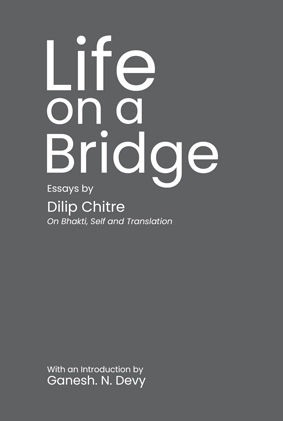
The essays and transcripts of Dilip Chitre brought together here are valuable in themselves as they offer a commentary on the Indian sense of tradition and the contemporary attitudes to literature. Every piece is of interest in itself. But, their greater worth lies in that they articulate the perspective of one of our most admirable poets on many issues that mattered to him. Taken together, they provide a basis for fathoming his poetry and should help us in making a more nuanced sense of it. Chitre was a fascinating poet, but it is not possible to say that his poetry was easily accessible to most of his readers. Like W. B. Yeats, he weaves in his poems experiences that arise in a given moment (such as the felling of a tree in his father’s house) together with many layers of timeless human quests and anxieties. He brings together silence and euphoria in an imagistic mix that is difficult to name with any precision. It is hence that this
volume of his comments, essays, lectures and other texts should be of importance for the lovers of Dilip Chitre’s literary works.
– Ganesh N Devy
Related products
-

ON THE BRINK OF THE ABYSS
$16About the Book
The fascinating aspect of Zingonia’s poem is the paradoxical unity of the two qualitatively different domains of the earthly and the spiritual. The two are interfluent. Though the culmination of the poem is in the divine love, I prefer not to read the poem in a linear way like in linear spiritual narratives such as Pilgrim’s Progress or Divina Comedia. Here, as in TS Eliot’s Four Quartets, past and future always move to the end – what is always present – and the end is in the beginning. It is pointless to trace the narrative or paraphrase Zingonia’s On the Brink of Abyss – a series of epiphanic moments of poetry at its intensest. The only justice a reader and critic can do to this wonder of a poem is to resonate with those ineffable epiphanies that have somehow slipped into language. What more can I do except to share with readers the way I
resonate with those precious moments of epiphanic agony and ecstasy. And congratulate Zingonia on this rare achievement which has no parallel in any poetry I know of.
– H.S. Shivaprakash
Poet, playwright, literary scholar and translator -
Broomrider’s book of the dead
$26About the Book
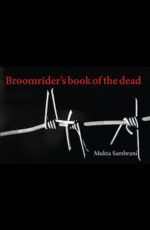
Mukta Sambrani’s The woman in this room isn’t lonely is a book of surprising intensity and imagination. Sambrani has a lyricism and fanciful imagination seldom seen in English-language poetry in recent decades. A poem about a man and woman in bed is anything but sentimental. Sambrani’s economy, independence of mind, hard-headedness and irony combine into a rapidly dramatic scene, which within twelve lines becomes grotesquely comic…By now there is a tradition in Indian poems of the coming of poetry as something mysterious. Sambrani’s version is totally unexpected. Bruce King, Modern Indian Poetry in English. Mukta Sambrani’s poems in Broomrider’s book of the dead are notable for their extreme strangeness. The book-length sequence is presented as the working manuscript of its fictional protagonist, Anna Albuquar, whose project is to ‘renegotiate the idea of authorship.’ There are asides, hesitations, false starts, instructions to the reader, and throughout, a steadfast regard for language. Jeet Thayil in Fulcrum and Bloodaxe book of contemporary Indian poets Broomrider’s Book of the Dead…is experimental in every sense… a crowded collage and an eloquent concoction that will make you look up all the references it states or implies…Sambrani said that her protagonist was obsessed with capturing memory “beyond constraints of time and place, beyond decay, illness and the failing of the body. She is obsessed with writing about writing. I am curious about the architecture of our experience. As we move toward a world that is hyper-digitised, our psyches become more and more of an orchestration of fragments of media, sights, sounds, words and visuals. Anna’s writing leans back to lean forward. It captures the history of writing through writing in a world that constructs itself out of fragments of media.Lora Tomas in The Sunday Guardian
-
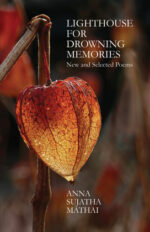
Lighthouse for drowning memories
$16About the Book
It’s in Delhi, dystopian as ever, that Sujatha Mathai continues to live and write today, and I fear her words—“I cannot save my city / Against the degradation of dust”—will echo long into the future, acquiring new meanings. And yet I’m so happy to read a new book of hers, to see that she’s still writing her poems sharp and clear as glass, full of sympathy for the world and those who suffer. It makes me feel that literature survives and helps us survive, that it carries more continuity than we think.
— Vivek Narayanan
Assistant Professor, Department of English, George Mason University -
Obsessed with Life
$10About the Book
“Mozetič’s verse conjures a distinctly gay way of looking at the world. It is both placid and paranoid, opening the world into paper-thin layers of sex, loneness and non-disingenuous self-reflection. His lyric has a remarkable flow, his language is persuasively simple, and his tone is forthright, all of which give the shattered heart at the core of this book a strange magnetic force.”
– Akhil Katyal, poet, translator, scholar and queer activist
-
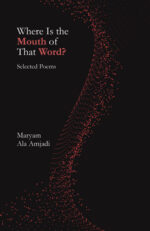
Where Is the Mouth of That Word?
$16About the Book
I breathed. I looked up. I saw her standing in the line of fire, “simply standing/on the last line of
this page”, asking, as she looked me in the eye, “Where are you reading from?”And that, dear readers, who are about to encounter Maryam’s poems for the first time, is the
question.
You can Google her, you can hear her speak 1 , you can explore her intersecting engagements as an essayist, translator, and academic.
But first, you can find her here, as I did, in a selection of her poems – from early to later, from the spoken word to the “vocal infection of the page”, from rant to reflection, plea to command.
You could, in obeyance, “Turn the page, and leave!”
You could be sentenced
to an expired word:
(Silence)You could hear the tanin (echo) of Sepehri’s hich (nothingness) reverberating at the same frequency with which you see Dali’s ‘The Echo of the Void’ hovering in your line of vision.
You could, and you will.
For now, all that matters is knowing (asking!) where you read from.
And as for the title we eventually chose – where is the mouth of that word?
Wherever there is one – fearless enough to speak it.– Sampurna Chattarji
-
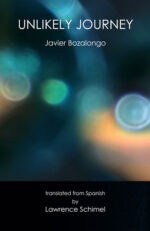
UNLIKELY JOURNEY
$12About the Book
As happens on all trips, in the pages of this book we find unforeseen questions and unexpected landscapes. These verses are transparent because they speak to us not about what is intuited or remembered but what is seen while trying to establish order, specify limits, and vanquish shadows.