| Author | |
|---|---|
| Imprint | |
| Language | |
| Edition | |
| Publishing Year | |
| Pages | 106 |
| Binding |
About the Book
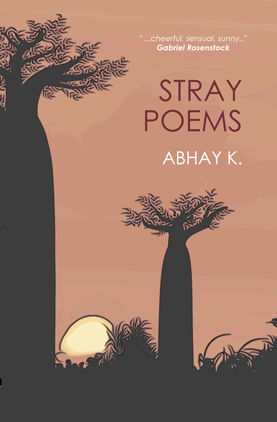
Abhay K. strikes such a cheerful, sensual and sunny note in so many of his individual poems…with a pure, ringing sound and rhythm all of his own.
—Gabriel Rosenstock, Poet, Ireland
Abhay K. is a trusted guide to modern poetry, to the journey in which we are seeking truth, peace and justice…feel the spirit of God coursing through his lines.
—Indran Amirthanayagam, Poet, USA
About the Book
Stray Poems takes you on a poetic ride across the world, to the moon and planets in our Solar System and to the far reaches of the Universe and then back to our glorious Earth! Bon Voyage!
Related products
-
The Acrobat Of Oblivion
$10About the book
Maximum Security Guilt is a jail built around the soul brick on brick it holds back the free movement of the mind, the simple gesture of the heart. Brick on brick the sinful bricklayer learns the mastery of the engineer, of the painstaking.
-
-
Collected Poems
$20About the Book
Adman, householder, mystic, public intellectual and ashram devotee, Kersy Katrak (1936-2007) has never quite received his due as a poet. Katrak’s ‘lush, provocative, and very readable’verse has, with its rare but persistent appearance in anthologies of Indian poetry in English, remained in a curious way at once unforgotten and unrecognized. This book aims, at long last,to remedy this state of affairs. It is the very first comprehensive collection of Katrak’s poetic work, most of it long out of print,some of it previously published only in hard-to-find periodicals. Katrak’s poetry resonates powerfully with Wallace Steven’s observation that ‘It is equal to living in a tragic land, To live in a tragic time’. His concerns remain,palpably,our concerns: a search for the everyday alchemy that might translate the visceral potentials of collective life into generative forms of belonging. This problem of the relation between inner energies and outer forms is at the core of Katrak’s work as a poet and a mystic. And it is what binds his esoteric commitments to his career in advertising. The anthropologist William Mazzarella’s critical introduction to the present volume is the first substantive exploration of these connections in Katrak’s life and work.
-
Grab your heart & follow me
$3About the Book
“In my wonderland, there are only beginnings, ‘there is no end’. Plunge into this book of?poems by Claus Ankersen where cat-gods rule, babies are born with stargates for eyes, kisses are catalogued and the 12th pen writes of celebratory sins. Expand the eternity of now. Be nomad, tiger, ‘soulhuntress.’ Head-dive into the mysteries of the world. Dance
-
159
$12About the Book
Nabanita Kanungo’s collection is simultaneously an elegy and a victory song. A documentation of the heartbreaks that have plagued our subcontinent for the past century or so, her poems re-define the lyric form, chronicling the unfolding of a personal self framed by larger political events. Here, history appears as a long, continuous saga of violence, in which Partition memories remain juxtaposed within the everyday lived realities and violences of neoliberal Indian cities. With this collection, Kanungo provides a ghostly account of quotidian survival?stories that remain forever out of official histories?and re-defines the meaning of Anglophone India political poetry of contemporary times.Nabanita Kanungo’s poems ache with an awareness of how poetry cannot truly evoke anything but absence, of how ‘It rains and words say nothing’; ‘Only memory is green’. In this tragedy, Kanungo finds the only solace available to the poet: a luminous quality in the every day, the ‘Mirror where things are simply written with light’. These poems work in the liminal spaces of the world and of the self, between the present moment and its turning into memory, between words and rain.
-
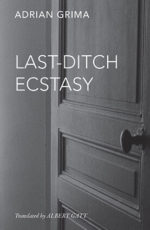
Last-Ditch Ecstasy
$14About the Book
Adrian Grima in collaboration with his talented and unusually resourceful translator, Albert Gatt – has produced a rich and memorable compilation of poems. Their geographical and emotional stew is international in its flavours yet always Maltese in its complex marinations. Grima succeeds in being – and these are potent combinations – both lyrical and true-to-life, both tender and unblinking, both comforting and challenging. His collection is a thought-provoking joy.- Jim Crace
How can the soul survive the world’s brutality. This is the essential, unanswerable question that Adrian Grima asks in and through his poems, beautifully translated from the Maltese by Albert Gatt. Taut with unexpected collusions, the poems walk the tightrope tensions of time and space. Turmoil, both emotional and political, is contained within the ascetic rigour of the lines; the mysteries of the distant are brought closer through eyes and lips, taste and touch. In Grima’s world, a lull can be as keen as a knife, blood can be the ultimate betrayal. An arterial anxiety courses through his work. Between “thistle and sun”, between skin and skin, between “departure and return”, the poet repeatedly alerts us to the heart-breaking fragility of the body, besieged. Coexistent with his bruising awareness of damage is his faith in contact, in simple human pleasures, a conversation, a pot of flowers, a meal. Deeply intelligent and moving, here is a book with “sky in its wings, migration in its heart”. Read it, be shattered, then soar.- Sampurna Chattarji