-
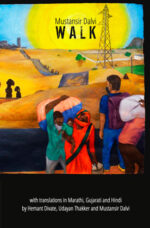
WALK
$20About the Book
This is a breath-taking experiment involving three poets, four languages, a pandemic and a million miles of migration. You will not find a bleeding heart here nor any cheap sentiment. Here is a watchful eye and a savage tongue. Here is a calligrapher’s pen and a bow to Ezra Pound. Mustansir Dalvi’s poetry has always meant something more to me than the best words in the best order. Here he shows us the order of things in a disordered world and we are humbled by this act of bravery and of empathy.
Jerry Pinto, poet and translator
Asylum, I want a poem and other poems
First published as an e-chapbook by Yavanika Press in that dreadful plague year, 2020, Mustansir Dalvi’s brilliant and memorable WALK is an act of homage to the suffering of those millions of Indians, already living precariously between village and metropolis, who were turned into migrants in their own land – forced to walk thousands of miles home, on what was effectively a death march, by a callous State and a society that improvises rather than systematising effective forms of compassion.
WALK now returns, under the Poetrywala imprint, as a surging polyphony. Dalvi is joined in this splendid quadriga of a book by Hemant Divate and Udayan Thakker, who have translated these poems into Marathi and Gujarati respectively; the author has rendered himself into a vibrant Hindi. This relay of versions is completed by Sudhir Patwardhan’s painterly testimony to the anguish of the Covid refugees caught up in a humanitarian catastrophe. A poet and translator, Dalvi infuses his writing with multilingual resonance and quicksilver diversity, shuttling among idioms and registers, in-group argot and makeshift patois. As befits the gravity and universal urgency of its subject, this book will reach readers in four languages simultaneously, saying to them, to us: Never forget!
Ranjit Hoskote, Poet, art critic and cultural theorist
-

The Tattooed Teetotaller and other wonders
$18About the Book
We say mind the book, it’s out of control.
But it’s author says
‘Nonsense verse helps its writers escape their resident demons,
setting them free to deal with the more transient ones of mischief.
At time I’ve tried to use that freedom to highlight contemporary absurdities,
at other times to write about those of a not-too-distant colonial past.
Readers will find that not everything here is nonsense, like the poem below.
But I hope they also find that however disastrous our falls into folly may be,
they can also be luminous’
Like Dictators
Rats are strict in their regulations.
Like dictators they regulate
meals and nations
along lines of bite. -
-

Abstract Oralism
$20About the Book
Yamini Dand Shah, with this new book Abstract Oralism, captures both precisely and remarkably the mysterious and elusive world of the Kachchh of Western Gujarat. Her metaphors and similes transport the reader towards this ancient terrain where Indus Valley peoples once flourished. Conceptually advanced and sophisticated, the poetry of this book causes us to reconsider our place in the world: in the light of the author’s extraordinary perception that translates earthly experience into a uniquely beautiful expression of the human condition.
-KEVIN MCGRATH, Poet Laureate, Harvard University
In the ‘Abstract Oralism’, Yamini reveals the beguiling mythic and mimetic history of the dangerously luminous, sensuous, and ephemeral beauty of the desert of Rann of Kachchh leaving us astonished and redeemed at once. ‘Sifting through soiled pages of an anti-modern, abridged dictionary’ of memories, she weaves embroidered tales of palaeolithic biographies of forgotten people in an experimental genre of speech-therapy with fierce emotional power. By turns poignant, playful and ironic, Yamini’s deceptively layered linguistic dreamscapes break new ground in experiencing hallucinatory minimalism in poetry. A mesmerizing debut!
-ASHWANI KUMAR, Poet, Writer and Public Policy Researcher
-
Hereafter
$16ABOUT THE BOOK
Hereafter is astonishing as a first volume, each poem adroitly handled with the freshness of youth and the ability only maturity grants. It could stand out with the best poetry on equal terms . I found each poem tightly structured, with not a word out of place. Only a gifted poet assured of her abilities would attempt to ‘tease the contours of a poetic line… to coax it out of its taut shell.’ Stuck in my memory are the lines from an anti war poem:
where every supper could be the last / where every candle is lit for the dead / where every prayer is a cry of the living / where every string is tuned to a requiem.
-Keki N. Daruwalla
Sophisticated, intelligent poetry for an international readership, marked by a flair for history and genuine compassion for sentient beings. Sabitha is as much at home with the ordinary as she is with
the bizarre:
At two at night
a bloated Lord Krishna
floats up, dead
in the Yamuna.
One is not likely to forget such lines in a hurry. What a debut! Where does she go from here? I’m already looking forward to her next book.
-Gabriel Rosenstock
-
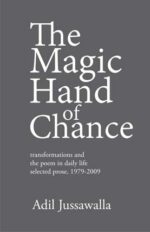
The Magic Hand of Chance
$24ABOUT THE BOOK
Covering a range of subjects, mainly to do with poetry, its daily interventions, its work, this book adds to the selections of Adil Jussawalla’s prose that have appeared before: in Maps for a Mortal Moon, and in I Dreamt a Horse Fell from the Sky. In his chapter on Jussawalla in a forthcoming book, Vidyan Ravinthiran says ‘[His} time-shifts don’t feel erratic because his prose only becomes inexact when to do so seems the only option – when it comes to resisting subliminal pressures. Every sentence is saturated with thought, changes are rung on prior phrases, in a manner inspired by real-world vexations but not without an element of self-relishing play.’
Poetrywala is happy to offer you more such prose.
‘To observe, to give witness, to hold in the memory the bereaved cow, the boy who has come to deliver the groceries, the poet in transit, the little boy who wet his pants laughing and who wept because a bird died, all these pass under the Jussawalla scanner, all these are transformed by the act of writing. Jussawalla’s fight against the Indian predilection for amnesia is relentless. He will not let you forget.’ – Jerry Pinto, from his Introduction in Maps for a Mortal Moon
‘Jussawalla’s curiosity is patently omnivorous and extends far into many disciplines and knowledges, drawing not least on Parsi, Hindu and Christian sources, science and social science, local politics or birdwatching. A continual subtheme throughout is the memory of Britain and Europe in the post-war years… considered not from an outsider’s point of view but with the deepest sympathy.’
– Vivek Narayanan, from his Introduction in I Dreamt a Horse Fell from the Sky
-
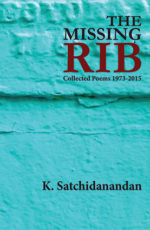
The Missing Rib (PB)
$40About the Book
This is a dark, powerful, pulsating collection of poems, the effect of which continues to reverberate, disturb and shock one out of one?s complacency long after one has finished reading them.. The Hindu (reviewing So Many Births) Satchidanandan’s poetry is an irresistible mix of the real, surreal, intellectual, sensual, and spiritual. Satchidanandan does not shy away from asking deeper existential questions -of being, freedom, love, compassion, nature, language, death Shanta Acharya (reviewing While I Write in Modern Poetry in Translation) Satchidanandan’s ‘I’ tells stories about itself, and like all good story-tellers, by telling its own story, his ‘I’ ends up telling stories about others as well. There is an ethical bent in this aesthetic enterprise, where fondness and empathy towards others enter your lines and transform your poetry the way they once transformed your life. Manash Bhattacharya (reviewing While I Write in Biblio) K. Satchidanandan is definitely not a poet who keeps aloof from the world. He is a poet on a journey.. Poetry for him is a cry against all walls? It is his cosmopolitanism that makes Satchidanandan interesting beyond India. Dr. Wolfgang Kubin (Reviewing the German collection, Ich Globe Nicht an Grenzen in Orientierungen: Zeitschrift zur Kultur)
-
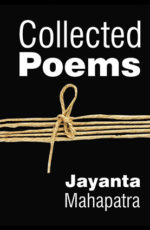
COLLECTED POEMS
$60About the Book
?Mahapatra?s is an elite art, aimed at a small, discriminating readership.?- Bruce King
Jayanta Mahapatra is indisputably the most innovative, progressive and Anglophile poets of modern India. He is intrinsically touched by the stark realities of our country, and writes instinctively about ? hunger, myths, traditions, customs, rituals, love, passion, anger, frustration, sex, the self and the eternity, the socio-cultural diversity with adroitness. His extant work exudes post ?colonial leanings and spirit invariably. Post- colonialism refers to those theories in texts, political aspirations and modes of activism that spur to challenge structural inequalities and to establish social justice. Mahapatra?s poetry unravels many facets of post- colonialism as haunting past, search for identity and roots. Mahapatra writes to enliven the native tradition protesting the former colonizers and establishing national identity and integrity. He evokes the sense of Indianness both in content and form through his poetry relentlessly. His symbols and images are, however, evocative, suggestive and pivotal for linguistic versatility.- Mirza Sibtain Beg
-
-
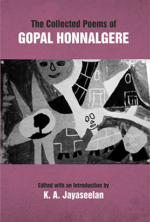
The Collected poems of Gopal Honnalgere
$30About the Book
‘Thank God all men need not drink water from the same source’: this line from one of Gopal Honnalgere’s poems collected here is perhaps the most suggestive comment that can be made on these poems as they draw their ‘water’ from sources seldom used in the Indian poems in English we are generally familiar with. An act of retrieval as well as of love, this collection lights up an ill-lit by-lane seldom taken by the urbanised Indian poets in English : the Zen of the Everyday and the Small: objects, insects, people, relationships. I read these in Malayalam where they were quite at home and so they will be, in any Indian language.
K. Satchidanandan
-
Inverse
$20About the Book
Rodríguez Núñez’s poetry has long been well-received in the Spanish-speaking world, by his predecessors and contemporaries alike. Juan Gelman (Argentina), for many the best contemporary Latin American poet, considers him to be a “true poet… baptized by poetry at birth.” And Raúl Zurita (Chile) declares, “Víctor Rodríguez Núñez’s poetry represents a profound renewal of poetic language. It forces us to see that poetry accounts for itself precisely because it accounts for the world.”
Likewise, his work has made a great impact far beyond the borders of the Spanish language. Lasse Söderberg (Sweden) writes, “[b]eing an independent Cuban poet is hard. Supporter or dissident?… Rodríguez Núñez doesn’t write the way either side expects him to.” John Kinsella (Australia) notes this poetry demonstrates a “stunning brinkmanship in imagery and poetic imagination that leaves the reader breathless and astonished. Technically, his is one of the most assured voices in contemporary poetry.”
And then, to ask myself, as his translator into English, how to cross the borders of language? With the same defiance found in the original. To avoid the trap of exotification, striking a balance between… the strangeness of certain words unlikely to
be associated with what is “typically Cuban,” and the similar strangeness of keeping words only a Cuban would understand. Inverse serves to introduce Indian readers to one of contemporary poetry’s most relevant, powerful voices. These poems challenge every limit; here, commitment and experimentation, emotion and lucidity, what is another’s and our own, the writer and the reader, come together.Katherine M. Hedeen
-

CALLING OVER WATER
$16About the Book
Praise for Priya’s Poetry:
Written over a decade, Calling Over Water features poems in three movements. The first trails a wake of lacunae and dislocation but also remembrance and gratitude for departed loved ones. Next, the tempo shifts as the mind sifts through dazzlement, disappointments, riddles and resolutions. Poetry making and identity are explored and mapped. In the last movement, geographies of space and time are located through art, history and the act of journeying. The self is in part reconstituted and returned as a retuned being. “Are you recyclable?” “Why does art leap out of the window when there’s no terrorist attack, only collapse?” “What if you stop smelling of loathing?” These are some of the brave and probing questions Priya Sarukkai Chabria poses in Calling Over Water.
-

Shorelines
$14About the Book
In his poem ‘Sailing to Byzantium’, W.B.Yeats sees himself transformed into a golden bird after his death. The bird is meant to entertain the city’s lords and ladies by singing of ‘what’s past, or passing, or to come.’ In the real and imaginary Byzantiums we inhabit today, Adil Jussawalla’s poems have a similar purpose – to tell, foretell, and uncover the ravaged face of the present.
‘He’s there on that street, making sounds that belong
to lands nobody knows, not in this world,
past sailing, past understanding.’
– from Jussawalla’s poem ‘Navigation Marks’
Be afraid. Be very afraid.
– Jerry Pinto
These lines by Jussawalla—with their images of the maritime, the mortal, and the beyond— drop anchors that stun as they fall through hulls and remembrance. There is a sense of being at once behind the helm of The Flying Dutchman, and trying to find sea-legs.
This homage to a city, where tarpaulin allies with sky and weather, is rich in puns
(“Faults not our own”-The Earthquake) and absurdity (“This number does not exist./ This port does not exist./ They should have told you.”).
Shorelines is a treasure as immeasurable as its shipwrecks’.
–Arjun Rajendran -

Supremo 16/70
$2About the Book
Miguel-Manso has published 11 books of poetry since his debut,
Contra a manhã burra(2008). His critically acclaimed collections include Santo subito (2010), Ensinar o caminho ao diabo (2012), Tojo: Poemas escolhidos (2013), Persianas (2015) and Mortel (2018). He has collaborated with several theatre companies and directors, and has been invited as a participating speaker to literary festivals, lectures and poetry readings, in and outside of Portugal. He has written, produced and directed (in collaboration with João Manso) the feature film Bibliography (2013) – a journey on a raft down two Portuguese rivers and through five hundred years of literature. -
Modern Guilt
$2About the Book
A sense of evening pervades Christos Koukis’ Modern Guilt, translated into English by Katerina Anghelaki-Rooke and Elle Arscott. This twilight is historical, ridden by the background of the financial crisis in Greece, as much as poetic, where ‘we are rich in such a way that no bank condescends to accept us’. But like all things Greek, there is the sun, which peeks at odd places and throws light on hidden corners. In Koukis’ world, the sun glints, before setting at nine o’clock behind the Acropolis, even if ‘deep down, the light makes things difficult’.
It is in this sense that Modern Guilt holds a mirror to us, our anxieties and vanities. The earthquakes in Modern Guilt are political. History is ugly and ‘the country does not go to sleep with clear conscience’. Continuing in the tradition of the modern Greek masters, Koukis has use for antiquity, but this antiquity is not removed from history, its pain and betrayal. It provides no respite, only hard lessons. The financial earthquake of Greece is but one more link in that story.
Yet in its moments of crises, hope shines through —‘there is a feeling of life that never abandons us, an honest victory’. There is redemption in love and in the hope of love. Amidst the shadows, for Koukis it ultimately ‘doesn’t matter’, for even ‘Dresden was rebuilt and now it shines’.
-Amlanjyoti Goswami
-
Like Earth to Stars
$20About the Book
When Shivaprakash (b.1954) entered the arena of Kannada poetry in the ’70s, Kannada modernism had already exhausted its possibilities. Those disenchanted with the modernist introversion spearheaded a new trend called Dalit-Bandaya movement. Critical of both modernist self-consciousness as well as the loud politics of rebel writers, Shivaprakash forged his own poetic idiom, at once sensuous and spiritual, political and philosophical, inspired by the regional folk and Bhakti traditions of poetry. He moved away from the monologic and didactic modes of contemporary Kannada poetry to pioneer a new dialogic-mode in which personal and social concerns enter into debate with a multiplicity of Indian cultural traditions. His more recent poems of the last couple of decades written in different parts of the world have broadened the essentially dialogic nature of his poetry, engaging in wide-ranging debates with other cultures and civilisations without sacrificing his rootedness in his own Kannada-specificity. Currently Professor of Theatre Studies in Jawaharlal Nehru University, New Delhi, Shivaprakash is also an eminent playwright and translator. He has held several important administrative positions in the past including Editor, Indian Literature, and Director, Nehru Centre, Berlin. His works have been translated into various Indian and foreign languages including Spanish, Italian, Romanian, Lithuanian, German and Arabic and won him many prestigious awards in India including the Sahitya Akademi and Sangeet Natak Akademi awards. He is Honorary Fellow, School of Letters at the University of Iowa, USA. Shivaprakash’s major interests include yoga, tantra and other Indian spiritual traditions as reflected in two English books, Everyday Yogi and Guru: Ten Doors to Ancient Wisdom.
-
Equator
$12About the Book
Reading Adriana Lisboa’s poems one becomes aware that in the clear light of their precise articulations something secret is taking place. That “something / taking place in secret” can be as anguished as the poems are calm; as wild as the poems are poised. She dares ask any question and – even more courageously – dares answer (or accept that there is none). Poems that are tethered to terra firma can cut loose without warning; knowing can ambush you from anywhere. There are no dirty tricks in her work, no showy gestures. Instead, there is the animating intelligence of life lived acutely, on and through words, this impossible sustenance that poets seek, and only rarely – as in Lisboa’s case – find. In her able translator Alison Entrekin’s hands, Adriana Lisboa’s poetry offers an exhilarating oxygen, “freeing in the word / what the word seals in”.
Sampurna Chattarji, poetry editor of The Indian Quarterly
-
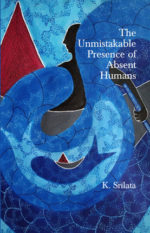
The Unmistakable Presence of Absent Humans
$16About the Books
In a world of loss and absences, K. Srilata’s concerns go beyond the personal into larger issues of disappearing languages and people in conflict-ridden zones. Her sensitive eye for detail, the unexpected images and her use of language that can be both sharp and delicate, make these poems memorable. – Menka Shivdasani, Indian poet
K Srilata, in writing this important collection, has given voice to all who struggle to find meaning, who wonder endlessly what that other reality might be – the one that lies just beyond our reach, just beyond the picture frame. Her writing invites us to see the unanswered questions as doorways back into our lives. I love Srilata’s book, her light touch, her true poetic-voice, and her ability to catch a poem on the wing and transmit it to her willing and excited reader. – Murray, Poet and editor of Poethead
-
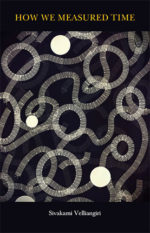
How We Measured Time
$12About the Book
“How we Measured Time by Sivakami Velliangiri, gives us poetry of a childhood remembered, perhaps now and then fictionalised –memory is such a dicey thing. The poetry is rooted in nostalgia, memories rooted in the house and the mill compound she grew up in, and yet there is no sentimentality attached to it. There are moments when the poetry is uplifting, her mother identifying ‘serpents/ by the design of their costume’, a grandfather lifting her ‘to the coastline of his shoulders’. And a past advances towards the reader, the silence before a solar eclipse, the hubbub of a Kerala elephant-chase.’
– Keki Daruwala