
| Author | |
|---|---|
| Imprint | |
| Language | |
| Edition | |
| Pages | 116 |
| Binding |
About the Book
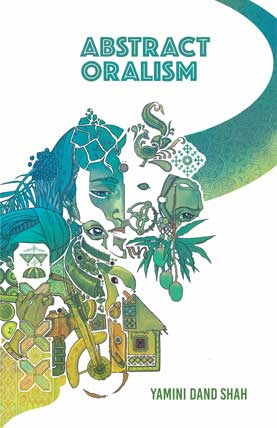
Yamini Dand Shah, with this new book Abstract Oralism, captures both precisely and remarkably the mysterious and elusive world of the Kachchh of Western Gujarat. Her metaphors and similes transport the reader towards this ancient terrain where Indus Valley peoples once flourished. Conceptually advanced and sophisticated, the poetry of this book causes us to reconsider our place in the world: in the light of the author’s extraordinary perception that translates earthly experience into a uniquely beautiful expression of the human condition.
-KEVIN MCGRATH, Poet Laureate, Harvard University
In the ‘Abstract Oralism’, Yamini reveals the beguiling mythic and mimetic history of the dangerously luminous, sensuous, and ephemeral beauty of the desert of Rann of Kachchh leaving us astonished and redeemed at once. ‘Sifting through soiled pages of an anti-modern, abridged dictionary’ of memories, she weaves embroidered tales of palaeolithic biographies of forgotten people in an experimental genre of speech-therapy with fierce emotional power. By turns poignant, playful and ironic, Yamini’s deceptively layered linguistic dreamscapes break new ground in experiencing hallucinatory minimalism in poetry. A mesmerizing debut!
-ASHWANI KUMAR, Poet, Writer and Public Policy Researcher
Related products
-

The Tattooed Teetotaller and other wonders
$18About the Book
We say mind the book, it’s out of control.
But it’s author says
‘Nonsense verse helps its writers escape their resident demons,
setting them free to deal with the more transient ones of mischief.
At time I’ve tried to use that freedom to highlight contemporary absurdities,
at other times to write about those of a not-too-distant colonial past.
Readers will find that not everything here is nonsense, like the poem below.
But I hope they also find that however disastrous our falls into folly may be,
they can also be luminous’
Like Dictators
Rats are strict in their regulations.
Like dictators they regulate
meals and nations
along lines of bite. -
Unmappable Moves
$20About the Book
Reading Unmappable Moves, I had the strangest sensation of time expanding and closing in. These are taut, enigmatic poems—lightning flashes with bright, insistent heartbeats.—TISHANI DOSHILethal tales of sex and death that left me pining for more of Sampurna Chattarji’s mysterious lyric inventions.—JEET THAYIL -
How We Measured Time
$12About the Book
“How we Measured Time by Sivakami Velliangiri, gives us poetry of a childhood remembered, perhaps now and then fictionalised –memory is such a dicey thing. The poetry is rooted in nostalgia, memories rooted in the house and the mill compound she grew up in, and yet there is no sentimentality attached to it. There are moments when the poetry is uplifting, her mother identifying ‘serpents/ by the design of their costume’, a grandfather lifting her ‘to the coastline of his shoulders’. And a past advances towards the reader, the silence before a solar eclipse, the hubbub of a Kerala elephant-chase.’
– Keki Daruwala
-
All That I Wanna Do (Marathi)
$16About the Book
Dear Sanjeev,
I read your poem yesterday ( last evening). Globalisation, and the consequent private Americanisation, corporatisation, computers, mobiles, mall culture and the decline of humanity
in every aspect of life is your concern, and mine too. That you and I have felt that comes with this new kind of life, and the regret that we feel because we cannot deter this decline or escape from it, the sarcastic presentation of the never-ending story of our contemporary miseries appear in your in the poem one after another; and interestingly (your) style neither accepts any poetic form nor it is written in any poetic language, and just as you were exhausted while carving a new definition of poetry, I was exhausted while reading your poem – this is what precisely I want to tell you by writing this exhausting second sentence. What you have expressed in this poem is the philosophy of this new way of life. Of course, I think it's significant that while presenting this philosophy afresh, you haven’t pretended that you are a philosopher!
Yours
Hemant Divate
August 28, 2004 -
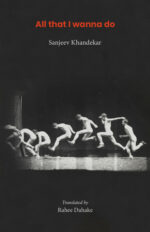
All that I Wanna Do (English)
$16About Book
Dear Sanjeev
I read your poem yesterday ( last evening). Globalisation, and the consequent private Americanisation, corporatisation, computers, mobiles, mall culture and the decline of humanity in every aspect of life is your concern, and mine too.
That you and I have felt that comes with this new kind of life, and the regret that we feel because we cannot deter this decline or escape from it, the sarcastic presentation of the never-ending story of our contemporary miseries appear in your in the poem one after another; and interestingly (your) style neither accepts any poetic form nor it is written in any poetic language, and just as you were exhausted while carving a new definition of poetry, I was exhausted while reading your poem – this is what precisely I want to tell you by writing this exhausting second sentence.
What you have expressed in this poem is the philosophy of this new way of life.
Of course, I think it’s significant that while presenting this philosophy afresh, you haven’t pretended that you are a philosopher!
Yours
Hemant Divate
August 28, 2004
-
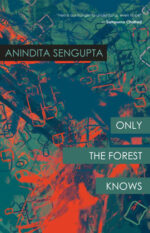
Only the Forest Knows
$20About the Book
“Wings sense what they must”. And poets too. In her third poetry collection, Anindita Sengupta receives and transmits the hues of a planet mad with want, fear, breakdown. At the heart of a maelstrom of (in)humanity and conflagration, dispossession and disease, her poems bite and rage and mourn. From forage fish to polar bears, she is enmeshed and implicated. With her, we sense the natural world’s mysteries as apprehensible, but “not teachable”. In these poems, breath is the seam that will rip and tear; pain the only climate we can count on. As we embrace deception and vulnerability, we coil in and out of the quieter spaces we contain and are contained by. Hers is our hunger to understand, even hope, so that we might begin again to believe in “small miracles”, to persist, like the algae, “in a world without light.”
– Sampurna Chattarji
Anindita Sengupta asks: “How to speak of violence without /repeating it. What language? What tone? What / memory?” Throughout this coruscating collection, her fluid and inventive poiesis attempts to answer these questions, weaving contingent and deeply human meanings out of personal and collective trauma. Only the Forest Knows is a profoundly accomplished, intelligent work. Sengupta creates an urgent, sensual language that speaks out of the raw contradictions and anguish of the present. This is a poetry tempered by fire, loss and sorrow that
yet, as Rilke said, “nevertheless still praises”: a hard-won beauty that is its own hope.—Alison Croggon
-
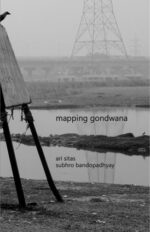
Mapping Gondwana
$16About the Book
I was moved by the ways in which, at key moments in the dialogue, rhythms shift, and instead of call-response between the poems, we go into each poet’s memory – a call-response between present and past. As they traversed back and forth between private parallel hum – after all, hum is “we” in Hindi – and direct synapse, I loved how freely they responded to both inner reverie and external stimuli. In some of Ari’s poems it felt like he was revisiting earlier trips to India – so that the duet was not restricted to what has just been received but what has always been residual – suggesting collaboration as a pretext – for return? Ari’s riverine contemplations counterpoint Subhro’s archetypal majhi (the boatman) made unmetaphorical. From Tagore’s golden boat to Subhro’s carbon kayak, what rapids have been crossed?
—Sampurna Chattarji
-
Life on a Bridge
$30About the Book
The essays and transcripts of Dilip Chitre brought together here are valuable in themselves as they offer a commentary on the Indian sense of tradition and the contemporary attitudes to literature. Every piece is of interest in itself. But, their greater worth lies in that they articulate the perspective of one of our most admirable poets on many issues that mattered to him. Taken together, they provide a basis for fathoming his poetry and should help us in making a more nuanced sense of it. Chitre was a fascinating poet, but it is not possible to say that his poetry was easily accessible to most of his readers. Like W. B. Yeats, he weaves in his poems experiences that arise in a given moment (such as the felling of a tree in his father’s house) together with many layers of timeless human quests and anxieties. He brings together silence and euphoria in an imagistic mix that is difficult to name with any precision. It is hence that this
volume of his comments, essays, lectures and other texts should be of importance for the lovers of Dilip Chitre’s literary works.– Ganesh N Devy