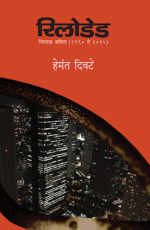
| Author | |
|---|---|
| Imprint | |
| Publishing Year | |
| Language | |
| Pages | 98 |
| Binding |

$16
In stock (can be backordered)
ABOUT THE BOOK
Hereafter is astonishing as a first volume, each poem adroitly handled with the freshness of youth and the ability only maturity grants. It could stand out with the best poetry on equal terms . I found each poem tightly structured, with not a word out of place. Only a gifted poet assured of her abilities would attempt to ‘tease the contours of a poetic line… to coax it out of its taut shell.’ Stuck in my memory are the lines from an anti war poem:
where every supper could be the last / where every candle is lit for the dead / where every prayer is a cry of the living / where every string is tuned to a requiem.
-Keki N. Daruwalla
Sophisticated, intelligent poetry for an international readership, marked by a flair for history and genuine compassion for sentient beings. Sabitha is as much at home with the ordinary as she is with
the bizarre:
At two at night
a bloated Lord Krishna
floats up, dead
in the Yamuna.
One is not likely to forget such lines in a hurry. What a debut! Where does she go from here? I’m already looking forward to her next book.
-Gabriel Rosenstock
Related products
-

Durable Transit
$22About the Book
Ravi Shankar’s poems are immortal in the flesh, finding in The life of the mind its interpretations, its instrumentality. The surpassing, transient, lyrical moment; and in the life of the World’s body the permanent, unflinching presence of thought, Unconfined by time and space. They are the verbal artifacts of a Singular, many-sided, and distinguished consciousness.Pulitzer Prize winner Vijay Seshadri Engorged with image, thick, viscous and churning, Ravi Shankar’s Poems have the density of mercury as well as its fluidity and Mobility…The energy is visceral. The language is restless, hungry For surprise, the register swinging between the formal and the Demotic (both American and Indian). Underlying this is an Almost voluptuous need to embrace myth, history, metaphysics And pop culture, and bring all of it into a single book, and Sometimes a single poem. This is matched by an alertness to form with references ranging from the Bop to the pada — making for A playful, stylistically supple poetry. – Arundhathi Subramaniam Ravi Shankar’s poems have a fine-tuned sense of form, a rare Delight in language. Through wit and abstraction, they reveal a Metaphysics of longing, binding us to the elements of our moving World. – Meena Alexander
Ravi Shankar is truly, now, one of America’s finest younger poets.-Dick Allen
-

Zingonia Zingonechya Kavita
$10About the Book
b.1967 is an internationally well-known Marathi poet, editor, publisher and translator. His published works include Chautishiparyantchya Kavita Poems Till Thirty-Four, Thambtach Yet Nahi Just Cant Stop and Ya Roommadhye Aale Ki Life Suru Hote The Moment You Enter This Room, Life Begins. His poems have been translated into English, French, Spanish, German, Urdu, Arabic, Gujarati, Bengali, Hindi, Oriya, Tamil, Telugu, Kannada and Malayalam. The celebrated poet and translator Dilip Chitre translated Chautishiparyantchya Kavita into English and titled the book Virus Alert which then has been translated into Spanish-Alarma De Virus by Zingonia Zingone and in Irish as Folireamh Vris by Gabriel Rosenstock.
-
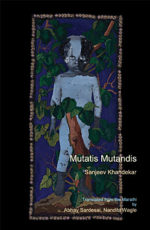
Mutatis Mutandis
$10About the Book
Through sex-dolls and addictions, for whom poetry can be just another narcotic throbbing in your vein. Khandekar’s man has stretched himself to the limits of the Machiavellian primate, modifying his behaviour and absurdum to fit in with the changing patterns of a world spinning out of control on the wheel of progress. Meet the ghost in the machine Sanjeev Khandekar’s poetry grins impishly, then socks you in the eye. It makes you feel horns on your head and inspect your skin for green stripes. Khandekar breaks conventions of belief, language and genre to offer a world with no certainties, where you are just a gob of self-awareness floating in a matrix of virtual reality, mutating every moment to balance your inner needs with social expectations. You are the Mutatis Mutandis Man the human ‘with necessary changes’ carried out the modified man tossed between inscrutable science and enigmatic religious faith, the creature who gropes for love and creativity that may lure you towards self-destruction. Meet Khandekar’s Monster and see if he seems familiar.
Khandekar’s poetry, like his art, is disturbingly unconventional; and Abhay Sardesai and Nandita Wagle’s excellent translation from Marathi now brings it to the English reader.
-Antara Dev Sen -
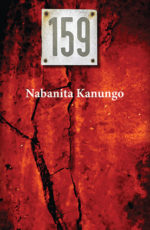
159
$12About the Book
Nabanita Kanungo’s collection is simultaneously an elegy and a victory song. A documentation of the heartbreaks that have plagued our subcontinent for the past century or so, her poems re-define the lyric form, chronicling the unfolding of a personal self framed by larger political events. Here, history appears as a long, continuous saga of violence, in which Partition memories remain juxtaposed within the everyday lived realities and violences of neoliberal Indian cities. With this collection, Kanungo provides a ghostly account of quotidian survival?stories that remain forever out of official histories?and re-defines the meaning of Anglophone India political poetry of contemporary times.Nabanita Kanungo’s poems ache with an awareness of how poetry cannot truly evoke anything but absence, of how ‘It rains and words say nothing’; ‘Only memory is green’. In this tragedy, Kanungo finds the only solace available to the poet: a luminous quality in the every day, the ‘Mirror where things are simply written with light’. These poems work in the liminal spaces of the world and of the self, between the present moment and its turning into memory, between words and rain.
-

Bookmarking the Oasis
$15About the Book
The poems in Bookmarking the Oasis slide between water and land as they reflect on boundaries, partings, and the identities thrust on us. Luminous, quiet, courageous, Srilata’s poems plunge into the poetics of the everyday, recording fugitive moments with humour, irony and compassion. Nothing escapes the poet?s eye, whether the classroom’s tyranny for both teacher and taught, the blindness of experts, the vulnerabilities of childhood, or the volatile interiors of the human mind. Some poems draw on other poets’ voices, beginning conversations and uncovering strange resonances. Connecting it all is the image of the oasis, unexpected, delicious; a serene, fluid clearing in the mind, bookmarked for later, that allows poetry – and everything else – to happen
-
-
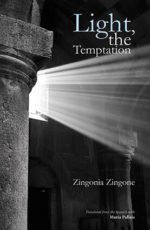
Light, the Temptation
$10About the Book
In Zingonia’s new poems it is a similar exercise that is happening. Instead of justifying the ways of God to men, these poems seem to me to be the ways of men and women to God. This daring act of a moment of surrender to the pristine unity of every thing cements the diverse poems here into one epic of mutations and metamorphoses. In this world the persona an Algerian beggar can merge into one of Jesus. Atoms and stars partake of the same reality as a flower. The fractured fates of Shen Fu, Maurice Utrillo and Max Jacob, which are acts of recurrent human tragedy become settings of Divine Comedy. Though the thrust of Zingonia’s poems is indubitably mystical, their mysticism goes beyond orthodoxies and heterodoxies of what is generally considered mystical. Their laconic beauty has the palpability of something militantly this- worldly as if Eternity is indissolubly in love with creations of time. At this point my words want to go back to the eloquent silence of these poems. I am sure other readers of this remarkable work will find these poems as enchanting and enlightening as I did. ‘Light, the Temptation’ is not a work to be read and abandoned. It invites us to contemplate on the rich resonances of its deceptively simple expressions in order to return the world to the world, ourselves to ourselves, meanings to our world where faceless robots are marching blindly towards irredeemable emptiness. – H S Shivaprakash (an excerpt from his introductory note)