About the Book
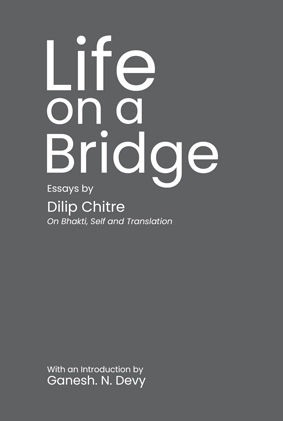
The essays and transcripts of Dilip Chitre brought together here are valuable in themselves as they offer a commentary on the Indian sense of tradition and the contemporary attitudes to literature. Every piece is of interest in itself. But, their greater worth lies in that they articulate the perspective of one of our most admirable poets on many issues that mattered to him. Taken together, they provide a basis for fathoming his poetry and should help us in making a more nuanced sense of it. Chitre was a fascinating poet, but it is not possible to say that his poetry was easily accessible to most of his readers. Like W. B. Yeats, he weaves in his poems experiences that arise in a given moment (such as the felling of a tree in his father’s house) together with many layers of timeless human quests and anxieties. He brings together silence and euphoria in an imagistic mix that is difficult to name with any precision. It is hence that this
volume of his comments, essays, lectures and other texts should be of importance for the lovers of Dilip Chitre’s literary works.
– Ganesh N Devy
Related products
-

Three Stories – Jibanananda Das
$10About the Book
Reading Jibanananda Das’s stories is like entering straight into the middle-class Bengali mind with its desire, ambition, morbidity and despair. Through the narratives around three men whose melancholy defines the structure of these three stories, the writer re-examines the concepts of success and failure, desire and fulfillment, love and weariness, ennui and death. While the insights are those of a poet, these stories marked by Jibanananda’s deep involvement with Bengali landscape, cuisine and culture, transcend his lyrical impulse to become proper, if technically innovative, short stories with the touch of a master of the genre. Chandak Chattarji’s English versions have been able to capture the provincial setting and style of the original narratives keeping intact their nuanced psychological implications and larger insights into the human condition.’ – K. Satchidanandan ‘It has been a privilege to discover Das the writer of fiction through Chandak Chattarji’s elegant and sensitive translation of three of the master’s short stories, ‘Chhaya Nat’ (‘Shadow Play’), ‘Gram o Shohorer Galpo’ (‘Tale of City and Village’), and ‘Bilash’ (which retains its original title here).’ – Ranjit Hoskote
-
Broomrider’s book of the dead
$26About the Book
Mukta Sambrani’s The woman in this room isn’t lonely is a book of surprising intensity and imagination. Sambrani has a lyricism and fanciful imagination seldom seen in English-language poetry in recent decades. A poem about a man and woman in bed is anything but sentimental. Sambrani’s economy, independence of mind, hard-headedness and irony combine into a rapidly dramatic scene, which within twelve lines becomes grotesquely comic…By now there is a tradition in Indian poems of the coming of poetry as something mysterious. Sambrani’s version is totally unexpected. Bruce King, Modern Indian Poetry in English. Mukta Sambrani’s poems in Broomrider’s book of the dead are notable for their extreme strangeness. The book-length sequence is presented as the working manuscript of its fictional protagonist, Anna Albuquar, whose project is to ‘renegotiate the idea of authorship.’ There are asides, hesitations, false starts, instructions to the reader, and throughout, a steadfast regard for language. Jeet Thayil in Fulcrum and Bloodaxe book of contemporary Indian poets Broomrider’s Book of the Dead…is experimental in every sense… a crowded collage and an eloquent concoction that will make you look up all the references it states or implies…Sambrani said that her protagonist was obsessed with capturing memory “beyond constraints of time and place, beyond decay, illness and the failing of the body. She is obsessed with writing about writing. I am curious about the architecture of our experience. As we move toward a world that is hyper-digitised, our psyches become more and more of an orchestration of fragments of media, sights, sounds, words and visuals. Anna’s writing leans back to lean forward. It captures the history of writing through writing in a world that constructs itself out of fragments of media.Lora Tomas in The Sunday Guardian
-

Salt & Pepper
$20About the Book
Salt and Pepper, Sukrita’s selected poems, present an eloquent, word-induced
silence articulated with remarkable ease. In the centre of the
multisensory, reflective silence dwells memory that pesters and heals, and
shapes a deeper understanding of self and existence, taking one beyond the
mere unmasking of a past. What adds luminosity to Sukrita’s densely textured
poems is the layered and fluid exploration of life experience, without any sense
of closure or finality. — Shafey Kidwai—-
Words are not just words, there is a long journey of emotion, thought and
experience behind them with which Sukrita weaves the weft and the warp of her
poems in shades of Salt and Pepper.— Nirupama Dutt
Girija Sharma: Silence emerges in these poems as a powerful metaphor in the interplay of
images which are impressionistic, symbolic and existential all at once. All noise is cancelled
–what remain are words in the purest form building a symphony of silence.
—-
Madhavi Apte: Sukrita’s poems are on the one hand illusive and on the other potent like her
own modern, abstract paintings. Most poems combine the elements of a mystique, the erotic
and the emotional, personal and impersonal. The poems are grounded and yet ethereal.
Basudhara Roy : Many-layered, teasing in its apparent simplicity, and haunting in its
profundity…Animated by her painter’s consciousness, Sukrita’s images are terse, pictorial
and at the same time, both concrete and abstract.
The compression, precision, lightness and luminosity of these poems is undeniable. There is,
in them, a simplicity, intensity and finesse that characterizes classical Eastern forms like the
haiku and the tanka.—–
Shyista Khan: the poems reflect an unmediated subjectivity… The
poetic consciousness borders between self-effacement and self
assertion…. -
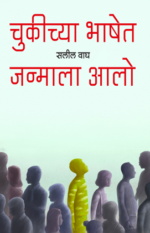
Chukichya Bhashet Janmala Aalo
$20About the Book
Saleel Wagh’s poetry represents a "post-nineties" (Post 90’s) shift in Marathi literature, characterised by a break from traditional lyricism toward a more fragmented, analytical, and metropolitan sensibility. His work explores the friction between a deeply rooted historical identity and the disorienting acceleration of the modern, globalised world.
1. The Linguistic Crisis: "Born in the Wrong Language" The central theme of Wagh’s work is the concept of linguistic inadequacy, as seen in the title "Chukichya Bhashet Janmala Alo" (I was born in the wrong language).
The Mismatch: This suggests that the inherited Marathi tongue is insufficient to articulate
the hyper-real, digital, and corporate experiences of the 21st century.
A New Idiom: By acknowledging this "wrongness," Wagh creates a space where slang, technical terms, and abstract philosophical inquiries can coexist with standard Marathi.
2. Temporal and Spatial Dislocation Wagh frequently uses imagery associated with time and physics to describe psychologicalstates:
The Mechanical Self: References to the "Minute hand" (Minutekata) and the act
of "jumping" suggest a life lived in increments of high-pressure bursts rather than a
continuous flow.
Hyper-awareness: The phrase "Kanat pran alela" (Life-force gathered in the ears)
depicts a state of modern anxiety and extreme sensory alertness.
Global Scattering: The poet observes that "the world is everywhere" and that the
self—likened to scattered beads—is dispersed across the world (Jagbhar), signalling
the loss of a localised, stable home.
3. Historical vs. Modern Landscape
A striking feature of Wagh's poetry is the juxtaposition of ancient geography with modern
existential dread:
Ancient Markers: By invoking "Bharatvarshe,"
"Jambudvipe," and "Dandakaranye," he places the reader in a vast, mytho-
historical timeline.
The Modern Ghost: Within these sacred spaces, he positions "Saleel
Prete" (Saleel’s ghost/corpse), suggesting that the modern individual exists as a
hollow or spectral figure within their own heritage.
4. The Fragmentation of Thought
Wagh’s imagery often focuses on the breakdown of unity:
The Broken String: He writes of the "string of the mind breaking" (Manachi maal
phutte), leading to a state where thoughts and identities—represented
as "beads"—are lost or scattered.
Sudden Flux: The description of "rafters whirring rapidly" (Sapasap vase phirle)
mirrors the chaotic, shifting architecture of both the modern city and the modern
mind. -
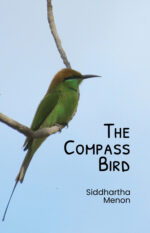
The Compass Bird
$15About the Book
Observant and meditative, lit with gentle whimsy, Siddhartha Menon’s work on the animal world leads us from ornithology to ontology, detail to dazzling insight, in a wingbeat. Here is a book in which the reverie of snails, the ‘mynahness’ of mynahs, the unhurried gaze of nilgai, becomes a way to reflect on all the eternal questions—time, belonging, love, purpose, a world ‘stained with stillness’, in which ‘those who attend have the last word’. One of the most delightful new books of poetry I have read this year.
– Arundhathi Subramaniam
-

Variations on Silence
$16About the Book
Throughout Variations on Silence, Nadia Mifsud draws us into intimate scenes and gestures,
as if overhearing lovers mid-conversation. The central figure – almost mythic in scale – is
silence itself, which Mifsud imbues with weight, texture, physical presence. Silence shelters,
stirs, shakes, unwinds, “tastes / of red soil and conifer.” Miriam Calleja’s translation conveys
the ache and longing of that silence with a sensual clarity rare in English. A fabulous book.
– John Wall Barger, The Elephant of SilenceAs Dante said, love is what moves the sun and the other stars – but it is also what flows
through all things, binding them together. This is what breathes in the silences – namely, in
the poems – of Nadia Mifsud : a listening rooted in love, which through love transforms and
reintegrates lovers into the cosmos, restoring the world to something deeply connected to
our humanity. Calleja’s admirable translation – herself a poet – captures this dynamic with
striking clarity and preserves it as the central energy of the work. The encounter between
these two poets ultimately offers us a book of poetry, not merely a book of poems – I repeat:
a cohesive and coherent work, held together by a vision both profound and vast. Ovid’s
Metamorphoses, Rilke’s Duino Elegies… The poetry found in this book is capable of
traversing time and resisting it, of crossing space to bind us – irrevocably – to this cosmos,
and in that bond, to reveal the secret of life.– Pietro Federico, Most of the Stars
Every verb in Nadia Mifsud's work shimmers, echoes, and rappels down the cliffside of a
stanza. Valences expand through repetition; "waves like jaws" locate the oceanic motion. One physically hears and feels the island of Malta in the tension between the isolation,
refrain, and the sea returning to shore, empty-handed. Miriam Calleja's attentive translation brings these affects and "sea-scented places" into English without forsaking the resonances and echoes of "cockleshells" past. Variations on Silence touches the hem where displacement circles the idea of place and results in lyric. The mode is modern; the echoes are ancient; the book is irresistible.– Alina Stefanescu, My Heresies