| Author | |
|---|---|
| Imprint | |
| Language | |
| Edition | |
| Publishing Year | |
| Pages | 80 |
| Binding |
About the Book
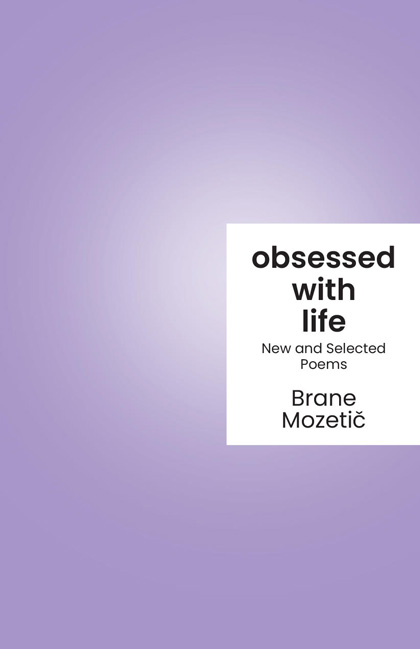
“Mozetič’s verse conjures a distinctly gay way of looking at the world. It is both placid and paranoid, opening the world into paper-thin layers of sex, loneness and non-disingenuous self-reflection. His lyric has a remarkable flow, his language is persuasively simple, and his tone is forthright, all of which give the shattered heart at the core of this book a strange magnetic force.”
– Akhil Katyal, poet, translator, scholar and queer activist
Related products
-

Grab your heart & follow me
$3About the Book
“In my wonderland, there are only beginnings, ‘there is no end’. Plunge into this book of?poems by Claus Ankersen where cat-gods rule, babies are born with stargates for eyes, kisses are catalogued and the 12th pen writes of celebratory sins. Expand the eternity of now. Be nomad, tiger, ‘soulhuntress.’ Head-dive into the mysteries of the world. Dance
-
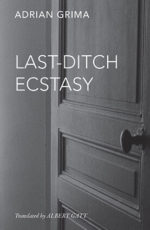
Last-Ditch Ecstasy
$14About the Book
Adrian Grima in collaboration with his talented and unusually resourceful translator, Albert Gatt – has produced a rich and memorable compilation of poems. Their geographical and emotional stew is international in its flavours yet always Maltese in its complex marinations. Grima succeeds in being – and these are potent combinations – both lyrical and true-to-life, both tender and unblinking, both comforting and challenging. His collection is a thought-provoking joy.- Jim Crace
How can the soul survive the world’s brutality. This is the essential, unanswerable question that Adrian Grima asks in and through his poems, beautifully translated from the Maltese by Albert Gatt. Taut with unexpected collusions, the poems walk the tightrope tensions of time and space. Turmoil, both emotional and political, is contained within the ascetic rigour of the lines; the mysteries of the distant are brought closer through eyes and lips, taste and touch. In Grima’s world, a lull can be as keen as a knife, blood can be the ultimate betrayal. An arterial anxiety courses through his work. Between “thistle and sun”, between skin and skin, between “departure and return”, the poet repeatedly alerts us to the heart-breaking fragility of the body, besieged. Coexistent with his bruising awareness of damage is his faith in contact, in simple human pleasures, a conversation, a pot of flowers, a meal. Deeply intelligent and moving, here is a book with “sky in its wings, migration in its heart”. Read it, be shattered, then soar.- Sampurna Chattarji
-
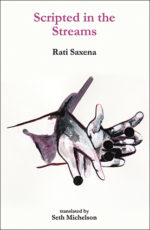
Scripted in the Streams
$12About the Books
There is an intense humanity in these poems by Rati Saxena, a humanity that ennobles all of us who are humble enough to listen. There is an empathy is these poems for all living things – for the spider, for the ant, for the owl – and a similar understanding of all things that may not be alive. -Alan Titley, Professor Emeritus of Modern Irish, University College, Cork It has travelled a long, long way this voice?and we welcome it as we would do a stranger, into the West where despair, decline and decay are seemingly permanent lodgers, Saxena’s lyrics arrive like a fresh breeze. New-born, fresh and smelling of the earth, her poems draw on the well of Indo-European tradition, the intimate links that bind the female psyche and the landscape in all its fecundity. -Dr Michel h’Aodha, University of Limerick Saxena allows for different aeons to melt into each other. She creates a world in which humans interact with insects and animals. We are all of and from the same source. The image of the snake is a powerful one to explain the frustrations of modern women in today’s India. Her vision makes a mockery of the boundaries around our lives and we sail with her through a magical world, coming into contact with the source of life itself. There are echoes of Flann O’ Brien in the delightful poem about the bicycle of her youth. Taboos and rituals will not enslave her and poetry finds its way into the washing on the line and the fire that bakes our daily bread. – Ceaiti Ni Bheildiuin, poet In this selection of the poems of Rati Saxena we are drawn into a world of imagery where deep respect is shown for the low -Brian O Conchubhair, University of Notre Dame, USA
-
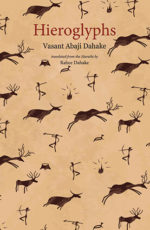
Hieroglyphs
$29About the Book
Hieroglyphs is a translation of Sahitya Akademi Award winning collection in Marathi- Chitralipi by Vasant Abaji Dahake. It has been translated into the English by Rahee Dahake.
-
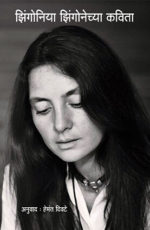
Zingonia Zingonechya Kavita
$10About the Book
b.1967 is an internationally well-known Marathi poet, editor, publisher and translator. His published works include Chautishiparyantchya Kavita Poems Till Thirty-Four, Thambtach Yet Nahi Just Cant Stop and Ya Roommadhye Aale Ki Life Suru Hote The Moment You Enter This Room, Life Begins. His poems have been translated into English, French, Spanish, German, Urdu, Arabic, Gujarati, Bengali, Hindi, Oriya, Tamil, Telugu, Kannada and Malayalam. The celebrated poet and translator Dilip Chitre translated Chautishiparyantchya Kavita into English and titled the book Virus Alert which then has been translated into Spanish-Alarma De Virus by Zingonia Zingone and in Irish as Folireamh Vris by Gabriel Rosenstock.
-
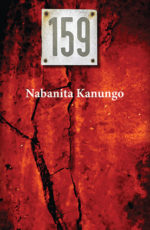
159
$12About the Book
Nabanita Kanungo’s collection is simultaneously an elegy and a victory song. A documentation of the heartbreaks that have plagued our subcontinent for the past century or so, her poems re-define the lyric form, chronicling the unfolding of a personal self framed by larger political events. Here, history appears as a long, continuous saga of violence, in which Partition memories remain juxtaposed within the everyday lived realities and violences of neoliberal Indian cities. With this collection, Kanungo provides a ghostly account of quotidian survival?stories that remain forever out of official histories?and re-defines the meaning of Anglophone India political poetry of contemporary times.Nabanita Kanungo’s poems ache with an awareness of how poetry cannot truly evoke anything but absence, of how ‘It rains and words say nothing’; ‘Only memory is green’. In this tragedy, Kanungo finds the only solace available to the poet: a luminous quality in the every day, the ‘Mirror where things are simply written with light’. These poems work in the liminal spaces of the world and of the self, between the present moment and its turning into memory, between words and rain.