
| Author | |
|---|---|
| Imprint | |
| Language | |
| Edition | |
| Publishing Year | |
| Pages | 80 |
| Binding |
About the Book
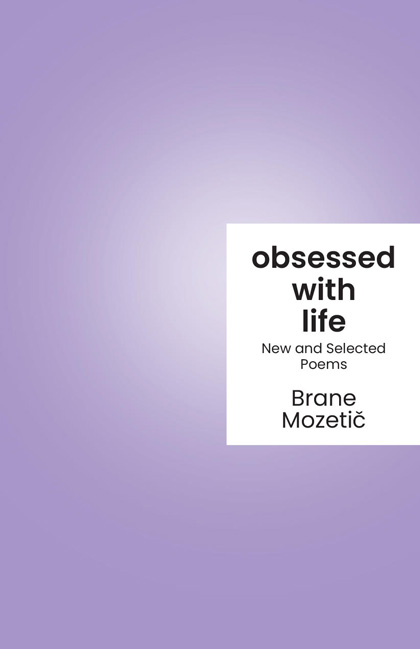
“Mozetič’s verse conjures a distinctly gay way of looking at the world. It is both placid and paranoid, opening the world into paper-thin layers of sex, loneness and non-disingenuous self-reflection. His lyric has a remarkable flow, his language is persuasively simple, and his tone is forthright, all of which give the shattered heart at the core of this book a strange magnetic force.”
– Akhil Katyal, poet, translator, scholar and queer activist
Related products
-
Scripted in the Streams
$12About the Books
There is an intense humanity in these poems by Rati Saxena, a humanity that ennobles all of us who are humble enough to listen. There is an empathy is these poems for all living things – for the spider, for the ant, for the owl – and a similar understanding of all things that may not be alive. -Alan Titley, Professor Emeritus of Modern Irish, University College, Cork It has travelled a long, long way this voice?and we welcome it as we would do a stranger, into the West where despair, decline and decay are seemingly permanent lodgers, Saxena’s lyrics arrive like a fresh breeze. New-born, fresh and smelling of the earth, her poems draw on the well of Indo-European tradition, the intimate links that bind the female psyche and the landscape in all its fecundity. -Dr Michel h’Aodha, University of Limerick Saxena allows for different aeons to melt into each other. She creates a world in which humans interact with insects and animals. We are all of and from the same source. The image of the snake is a powerful one to explain the frustrations of modern women in today’s India. Her vision makes a mockery of the boundaries around our lives and we sail with her through a magical world, coming into contact with the source of life itself. There are echoes of Flann O’ Brien in the delightful poem about the bicycle of her youth. Taboos and rituals will not enslave her and poetry finds its way into the washing on the line and the fire that bakes our daily bread. – Ceaiti Ni Bheildiuin, poet In this selection of the poems of Rati Saxena we are drawn into a world of imagery where deep respect is shown for the low -Brian O Conchubhair, University of Notre Dame, USA
-

Frazil
$16About the Book
Menka Shivdasani’s poetry is both original and strikingly unusual, not just her tangential way of putting things across, but also how thought process and imagination run away with the poem, and make it exciting. An experience is translated into another experience and then gets mixed with fancy in a juice blender. Chopping lettuce, she’ll be assailed by visions—burning bride, politician, a ‘wounded Hiroshima’, and finally a finger-chopping Nazi. A poem about separation will end with her handling ‘alien porcelain’ at a tea party. For over three decades the excitement she brings to her fine poetry has never deserted her.
-
Says Tuka-Selected poems of Tukaram
$30About the Book
Tukaram was born in 1608 and vanished without a trace in 1650. what little we know of his life is a reconstruction from his own autobiographical poems, the contemporary poetess Bahinabai’s memoirs in verse, and the later biographer of Marathi poet-saints, Mahipati’s account. The rest is all folklore, though it cannot be dismissed on those grounds alone. Modern scholars such as the late V. S. Bendre have made arduous efforts to collate evidence from disparate contemporary sources to establish a well-researched biography of Tukaram. But even this is largely conjectural.
Tukaram is therefore not only the last great Bhakti poet in Marathi but he is also the first truly modern Marathi poet in terms of temper and thematic choice, technique and vision. He is certainly the most vital link between medieval and modern Marathi poetry. Tukaram’s stature in Marathi literature is comparable to that of Shakespeare in English or Goethe in German. He could be called the quintessential Marathi poet reflecting the genius of the language as well as its characteristic literary culture. There is no other Marathi writer who has so deeply and widely influenced Marathi literary culture since. Tukaram’s poetry has shaped the Marathi language, as it is spoken by 70 million people today and not just the literary language. Perhaps one should compare his influence with that of the King James version of the Bible upon speakers of the English language. For Tukaram’s poetry is also used by illiterate millions to voice their prayers or to express their love of God.
-

Durable Transit
$22About the Book
Ravi Shankar’s poems are immortal in the flesh, finding in The life of the mind its interpretations, its instrumentality. The surpassing, transient, lyrical moment; and in the life of the World’s body the permanent, unflinching presence of thought, Unconfined by time and space. They are the verbal artifacts of a Singular, many-sided, and distinguished consciousness.Pulitzer Prize winner Vijay Seshadri Engorged with image, thick, viscous and churning, Ravi Shankar’s Poems have the density of mercury as well as its fluidity and Mobility…The energy is visceral. The language is restless, hungry For surprise, the register swinging between the formal and the Demotic (both American and Indian). Underlying this is an Almost voluptuous need to embrace myth, history, metaphysics And pop culture, and bring all of it into a single book, and Sometimes a single poem. This is matched by an alertness to form with references ranging from the Bop to the pada — making for A playful, stylistically supple poetry. – Arundhathi Subramaniam Ravi Shankar’s poems have a fine-tuned sense of form, a rare Delight in language. Through wit and abstraction, they reveal a Metaphysics of longing, binding us to the elements of our moving World. – Meena Alexander
Ravi Shankar is truly, now, one of America’s finest younger poets.-Dick Allen
-

First Infinities
$12About the Book
Hell, or a state very much like it, does feature in Nambisan’s poetic underworld, which is deep, intricate and enticing. …… – From the Preface by Adil Jussawala Nambisan’s view of humankind is bleak, his view of the possibilities of poetry even bleak
-
Brouhahas Of Cocks
$15About the Book
Hardback awakening The air is thick, and has revived my books, anticipating the first spell of a Bombay monsoon. Ambient moisture has slaked pages that shuffle and twist, arise to a wakefulness, unleaving. Feeling the discomfort of nearness,
-

Light, the Temptation
$10About the Book
In Zingonia’s new poems it is a similar exercise that is happening. Instead of justifying the ways of God to men, these poems seem to me to be the ways of men and women to God. This daring act of a moment of surrender to the pristine unity of every thing cements the diverse poems here into one epic of mutations and metamorphoses. In this world the persona an Algerian beggar can merge into one of Jesus. Atoms and stars partake of the same reality as a flower. The fractured fates of Shen Fu, Maurice Utrillo and Max Jacob, which are acts of recurrent human tragedy become settings of Divine Comedy. Though the thrust of Zingonia’s poems is indubitably mystical, their mysticism goes beyond orthodoxies and heterodoxies of what is generally considered mystical. Their laconic beauty has the palpability of something militantly this- worldly as if Eternity is indissolubly in love with creations of time. At this point my words want to go back to the eloquent silence of these poems. I am sure other readers of this remarkable work will find these poems as enchanting and enlightening as I did. ‘Light, the Temptation’ is not a work to be read and abandoned. It invites us to contemplate on the rich resonances of its deceptively simple expressions in order to return the world to the world, ourselves to ourselves, meanings to our world where faceless robots are marching blindly towards irredeemable emptiness. – H S Shivaprakash (an excerpt from his introductory note)
-
Mutatis Mutandis
$10About the Book
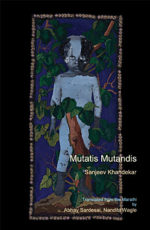
Through sex-dolls and addictions, for whom poetry can be just another narcotic throbbing in your vein. Khandekar’s man has stretched himself to the limits of the Machiavellian primate, modifying his behaviour and absurdum to fit in with the changing patterns of a world spinning out of control on the wheel of progress. Meet the ghost in the machine Sanjeev Khandekar’s poetry grins impishly, then socks you in the eye. It makes you feel horns on your head and inspect your skin for green stripes. Khandekar breaks conventions of belief, language and genre to offer a world with no certainties, where you are just a gob of self-awareness floating in a matrix of virtual reality, mutating every moment to balance your inner needs with social expectations. You are the Mutatis Mutandis Man the human ‘with necessary changes’ carried out the modified man tossed between inscrutable science and enigmatic religious faith, the creature who gropes for love and creativity that may lure you towards self-destruction. Meet Khandekar’s Monster and see if he seems familiar.
Khandekar’s poetry, like his art, is disturbingly unconventional; and Abhay Sardesai and Nandita Wagle’s excellent translation from Marathi now brings it to the English reader.
-Antara Dev Sen